Chapter 6
Will Jump for Beer
“Para-commanders are easy to steer—except when
you open up five thousand feet too high.”
—US Navy—
Immediately after Thanksgiving I checked into UDT 21 at Little Creek, VA. Several of the guys I met during dive school classes had already arrived. They were glad to see me, but my new jewelry caused quite a stir.
“Doc, where in the hell did you get the gold wings?”
“I ain’t never seen wings on a medic before. Did you mug a flyboy or what?”
“Didn’t have to.” I retorted, “These are mine, fair and square. I’m free-fall qualified.”
“No shit? We got us a jump-qualified Doc!”
Dick Wolfe checked in a few days after I did, giving UDT 21 two jumping medics, but by the time he arrived, the novelty was gone. I enjoyed being the first one in the door for once.
Being qualified allowed me to jump with the East Coast Jump Team. And I took full advantage of that fact, doing a few training jumps to learn how to handle the more sophisticated equipment used in exhibition jumps. Before I could get really proficient, however, it was time to go down to Roosey Roads in Puerto Rico for winter deployment. This was really tough duty. I had to endure the sunny weather in Puerto Rico while my family languished in the crisp Chicago Winter.
We were scheduled to return to Little Creek in December. But before I could pack, our Executive Officer, Fred Kochey asked me if I would consider staying on for a few months. It seemed that UDT 22, who were just beginning their deployment in Roosey Roads, were short a corpsman. Since we had two corpsmen, Dick and myself, he asked if I would consider postponing my return to fill out 22’s roster. For the greater good, I agreed to make the sacrifice. So I continued basking in the sun at Roosey Roads with UDT 22 while Dick and the rest of my unit left for the frozen north.
It was almost spring when I finally got back to Little Creek. My girlfriend Vicki met me there. She and I had known each other for years, growing up in the same town. Up till then, she had been content just to be my girl, but now she wanted to be my wife. I liked that idea, so we drove to Elizabeth City, North Carolina, and got married amid April flowers.
Back in Little Creek, the situation was difficult for Vicki, because we didn’t really know any couples. My idea of a night on the town was to hang out at the Jolly Roger, the Team’s watering hole. Vicki, on the other hand, was not all that fond of spending her evenings with a bunch of boisterous frogmen. My marriage might have ended soon after it began if I had not run into Frank Thornton at the Jolly Roger. He was with SEAL Team Two and was already a living legend in the Teams. Frank sat holding court near the bar with a group of admirers clustered around him. He was easily recognizable because of his devilishly good looks which had captured the attention of every single woman in the bar—and probably some not so single ones as well. This in turn had assured him the attention of every man in the bar. He looked far younger than his actual years.
I made a point of going up to meet him, and we soon hit it off. He and his equally attractive wife, Lee, ended up taking Vicki and me under their wings. I not only learned a lot from Frank, I owe him and Lee for keeping my fledgling marriage from ending almost before it started. With Lee’s help, Vicki met other wives in the area and we soon developed a social life outside of the Jolly Roger.
Just as I became really comfortable with the routine around Little Creek, Fred Kochey called me into his office.
“Doc, you’ve got to get over to the SEAL Team.”
The SEAL Team Two headquarters stood only a few buildings away from the UDT billets. I expected to be assigned to the Team eventually, so this was no surprise. Besides, I had already volunteered for the Apollo capsule recovery team. An assignment to Team Two would still allow me to participate in that mission.
“Super. I’ll get my stuff and carry it over.” I turned to leave.
“Doc, I don’t think you understand.” Fred stopped me. “You’re to report to the West Coast—SEAL Team One at Coronado.”
“Hollywood UDT!” I was stunned. I had always assumed I would be sent to Team Two, since I was trained on the East coast and my instructors were all from Team Two. The East and West Coast SEAL Teams had maintained a constant but easygoing rivalry since the first day of their commissioning. Each Team considered itself superior to the other. During my training I had acquired the East Coasters’ disdain of anything from the west.
“West Coast Pukes? No way. I want to stay here! I was supposed to be assigned to the Apollo splashdown crew. Uh, sir.” I added the last as an afterthought. No sense pushing him too far.
“Sorry Doc. They’re short a corpsman on a platoon scheduled for deployment to Vietnam, and you’re it. You report to Captain Dave Schiable in Coronado by June 1st.”
Vietnam. I hadn’t really expected to go back there so soon. Tucked away in the comfortable environments of Puerto Rico and then Virginia, I had almost managed to forget we had a war going on.
Fred understood my reluctance to leave the East Coast Teams. “It’s not so bad. Your friend Dick Wolfe is already out there. Oh, by the way,” he grinned, “once you’re out there, you’ve been requested for a Temporary Assigned Duty as one of the designated corpsman for the Apollo 11 splash down crew. You report to Lt. Tim Kenney at UDT 11, also based in Coronado. Your SEAL platoon doesn’t deploy until October, so you’ve got time to go help some astronauts. I’ll even authorize some basket leave so that you’ll have time to get your gear out to the west coast.”
That was the assignment I really wanted. It almost made up for having to drive to Coronado. When I told Vicki, about my orders, she was a little disappointed at having to leave her new friends, but understood that it was part of my being in the Navy. She helped me pack our stuff and we began the cross-country road trip to the Pacific coast.
After a very long drive, we finally arrived in San Diego. I left Vicki at our new apartment while I reported in to Team One at Coronado, a cozy little picture-perfect town located just across the bay from San Diego. I assured her we would have the weekend together, since it was Friday. There was no way they would give me an assignment over the weekend.
My certainty had not taken Chief Blackburn into account. The Chief Master at Arms of Team One, a mean-spirited corpsman who hated all other corpsmen, especially low-ranking medics like me had other plans for me.
“Well, Doc,” he sneered, “Guess you’re here just in time to take the weekend duty. I got a date to keep.”
With whom? Attila the Hun? I sighed. So much for a weekend with my wife. Vicki would understand. I hoped.
The only good thing about having the duty that weekend was that I ran into Dick Wolfe.
“Man, you are the prettiest thing I’ve seen since I got here!” I grabbed his meaty hand and pumped it hard.
“Don’t tell that to Vicki!” he laughed, “She may have second thoughts about marrying a man who thinks I look good!”
“Too late for second thoughts. Vicki is my wife now—and definitely better looking than you. But I haven’t seen much of her thanks to that sorry sack of a Chief.”
“Gave you the duty, huh?” He gave me a sympathetic grimace. “He got me, too. He loves to jerk over young corpsmen. I understand he’s not too fond of the older ones, either.”
He smiled at the obscene gesture I aimed in the general direction of the Chief, and then asked,” So which platoon did you get?”
“I’ve been assigned to Alpha.”
“God, you’ve still got the luck!”
“What the hell are you talking about? I just got here and I’m already scheduled for Vietnam.” Going back to ’Nam, especially with a SEAL platoon I hadn’t even met, much less worked with, didn’t exactly strike me as the best kind of luck.
“Yeah, but Alpha Platoon doesn’t deploy until October. That will give you some quality time with the old lady. Might even make up for this weekend. Kilo—my platoon—is already in pre-deployment training at Niland. I’m shipping out before the summer’s over—sometime in the next month or so. At least you’ve got a little time to get up to speed. I had to hit the ground running. And let me tell you, keeping up with these guys is no picnic. You think the Chief is bad? As far as these SEALs in Team One are concerned, all corpsmen are just pecker-checkers. They don’t believe any of us knows his way around a weapon, much less a war.”
I laughed at that, Dick being one of the few corpsmen besides me who had survived a tour in ’Nam with a recon platoon. But Dick’s survival record was even more impressive than mine was. He had actually spent most of his tour on the front lines.
“At least I won’t have to deal with Chief Blackburn much longer,” he continued, slapping me hard on the back. “That pleasure will be all yours, kid!”
I hesitated to tell him that I wasn’t sticking around either. Somehow I felt that telling him about my plum interim assignment to the Apollo splashdown crew would wreck the mood. I was scheduled to check in with Lt. Kenney on Monday. After that, Chief Blackburn would have to find someone else to pick on.
I signed in with Lt. Kenney as planned and began preparations with the splashdown Crew. We were not scheduled to go out to sea until the second week in July, so I had a little free time in my schedule. I was determined to find something to keep me busy enough that Chief Blackburn could not get at me again. Jess Tolison and the West Coast Jump Team provided the perfect solution.
Jess Tolison was a plank owner of Team Two, which meant he was one of the original members of the Team when it was first commissioned. He had spent most of his career on the East Coast and, like me, had deep feelings for the East Coast way of doing things. Jess received a transfer to the West and Team One upon accepting his commission as a warrant officer. He now headed the West Coast Jump Team.
The Jump Team needed one more skydiver to fill out their roster. Jess found out I was a recent East Coast transfer, and decided I might be the perfect choice for the team. He tracked me down one afternoon to find out if his suspicions were correct. Just short of medium height, Jess had a broad face and determination that reminded me of a bulldog. After swapping news about his friends back at Little Creek, he got down to business.
“So, Doc, Are you free-fall qualified?”
“Yeah. Why?”
He ignored the question.
“How qualified?”
“Well, I jumped with the East Coast Exhibition Jump Team.” I didn’t mention that I never actually got to do more than a few practice jumps with them.
“Great! That’s just what I wanted to hear. We need you for the Fourth of July demonstration. We’re practicing tomorrow.” The next day was the 30th of June—my birthday. It sounded like a good way to make certain I was far away from the Chief on that day.
“Have you got a para-commander?”
“Hell, I don’t have anything.” It had never occurred to me to bring a parachute with me from Little Creek, or to arrange to have one checked out, here.
“No problem. Let’s go over to the loft and see if we can’t fit you up.”
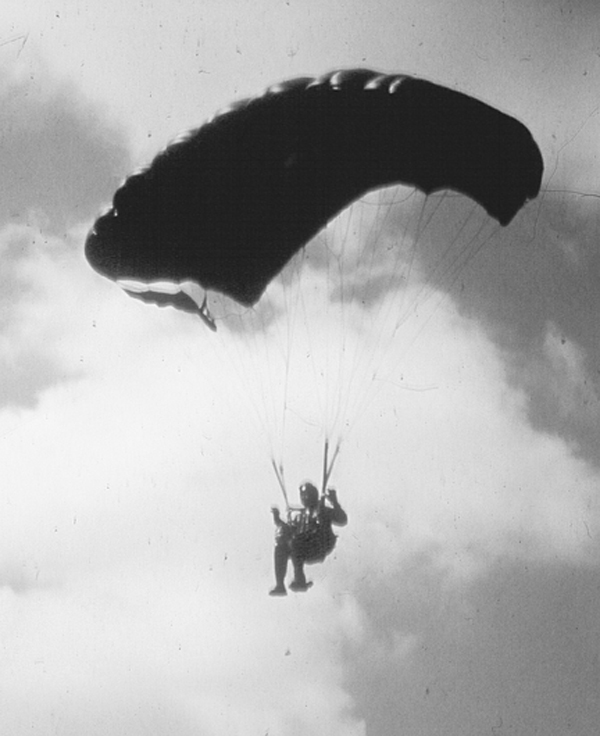
We drove over to the parachute loft, which was not really a loft at all, but a large building where parachutes and jump gear were packed and stored. It took only a short time to find and fit the gear I needed to be able to jump with the team. Para-commanders are very specialized chutes with an elongated design that allows the jumper to control and steer the chute once it has been deployed. Regular parachutes, such as those used in most large air-drops, allow for only minimal control, and are mostly victims of the wind. The much greater control allowed by a para-commander enables a skilled skydiver to land exactly on any given mark. They are designed with the altimeter and the stopwatch on the back of the reserve chute so that they can be read easily by the jumper to allow precision timing of the parachute release.
The next day, I met the rest of the team on the field, as we got ready for our first practice together. It was the end of June and the jump was scheduled for July 4th. We didn’t have much time.
“This is Doc Greg McPartlin.” Jess thumped me on the back. “He used to perform with my old compadres on the East Coast Jump Team.” I smiled and tried to look competent while struggling to remember how to rig my chute correctly.
“So, Doc. You gonna show us how it’s done back East?” A redheaded fellow challenged.
“Well actually, I’m still a novice, but ...”
“I’ll bet you are.” A short fellow named Tom snorted. “Okay, we’ll show you how we do it out here!”
I could tell they didn’t believe me, not after the buildup Jess had given. As the ground receded from view below me, I thought that perhaps I might have exaggerated my experience just a bit too much. These guys all had numerous free-fall performances behind them. I only had a few days of accelerated jump school and some practice jumps with the East Coast Team. It was a little late to ‘fess up now.
We exited the bird at about 10,500 feet. Cloud cover obscured the jump zone, making it difficult to get any bearings. And plummeting to earth from over ten thousand feet is a lousy time to discover you’ve put the reserve chute on upside down. My stopwatch and altimeter were on the bottom of the pack, facing away from me. With the air whipping by me as I fell, I began to wonder if this birthday might be my last.
After a moment, I discovered that by stretching to look over the pack, I could still see both instruments, but they were upside down. Good, I thought, No problem. I can compensate.
We were supposed to pop our chutes at just below one thousand feet, but the obscuring cloud cover made it impossible to judge distance to the ground except by altimeter. I imagined terra firma rushing up to greet me very quickly just beyond the clouds. I strained to read the gauges, pulling my chute when I thought I had passed one thousand feet. Unfortunately a 7 looks a lot like a 1 when it is upside-down. I had misread the inverted instrument, and opened up at about six thousand feet.
Now para-commanders are easy to steer—except when you open up five thousand feet too high. There is no way to compensate for the prevailing winds at such a high altitude. Instead of proving my skills and landing right on target with everyone else, I found myself caught like a leaf in a breeze, completely helpless as I drifted all the way across San Diego Bay, surprising the longshoremen at the National Steel Boatyards. They had never seen a SEAL drop out of the sky before, especially not into the middle of their boatyard.
I gathered in my chute and waited, hoping someone would come get me. About the time I was convinced they were going to make me walk back to base, a jeep full of SEALs arrived to fetch the team’s wandering parachutist.
“Uh, thanks for coming to get me.”
“We don’t give a rat’s ass about you personally. Around here the tradition is that the last man down buys the beer. That means you, Doc. We just came to be sure we got our beer.”
“I thought you knew what you were doing?” Tom bellowed as soon as I had loaded my chute into the jeep.
“Shit, that’s probably the way they do it on the ‘East Coast’.” Red quipped, “No wonder they sent him out here.”
My face as red as Red’s hair, I shot back “Hey, I’m sorry. I never said I was an expert. I just need a little more practice.”
Fortunately, they made sure I got more practice, a lifetimes worth in the four days remaining until the exhibition. But after a few more jumps I started to feel like a real part of the team. With each jump we improved dramatically, moving into and out of our formations with ease, until even Jess said we looked pretty good. The exhibition jump on the Fourth was scheduled to take place over Glorietta Bay, next to the Amphibious Base so the audience could watch from a large open area on shore. Directly across the bay lay a yacht club and a large golf course which provided us with a clear landing zone.
The day of the demonstration, a large audience gathered all along the shoreline to watch our show. As I entered the plane, Tom poked me and said, “Looking forward to another beer on East Coast Doc, here.” Everyone laughed but me.
When it came time to jump, we exited the plane in good order and quickly formed up on each other. Gathering up as we fell, we moved through the various formations almost flawlessly, ending by holding hands to create a human ten pointed star. On the count, we broke formation and separated to pull our chutes.
I was very pleased with our performance, but Tom’s comments on that first day still rankled.
I’ll show these sons of bitches, I thought to myself, I’ll be the first one on the ground and make up for opening so high in practice.
I passed one thousand feet while my teammates deployed their chutes and disappeared from view. As I hurtled towards the ground, I thought I could hear the collective gasp of the crowd when they realized I was still falling. But I wasn’t worried. I kept my eye out for the new Bay Bridge that spanned the distance from Coronado to San Diego. So new it hadn’t even opened yet. At roughly 250 feet in height, I knew I would be close to my planned limit of six hundred feet when I could see the Bridge. Still well within safety parameters, but lower than anyone else in the team.
I’m going to be the first on the deck, I though as I saw the bridge and released my chute. The audience got a better show than they bargained for, but I was comfortably in control of my chute when I passed the bridge. I made a clean, comfortable landing—always the most important part of any jump—and was bundling up my chute when the rest of the team touched down.
Jess released his harness and stormed over to me without stopping to bundle his chute, fury burning in his eyes. It took no time at all for him to share his thoughts, in graphic detail, on my jumping style.
“What the hell did you think you were doing?” he shouted, his square face inches from mine. “That may be the new way they do things on the East Coast, but I can guarantee you’re never jumping with my Jump Team again!”
Funny thing, that style of skydiving didn’t go over real well on the East Coast, either. At least I didn’t have to buy the beer.