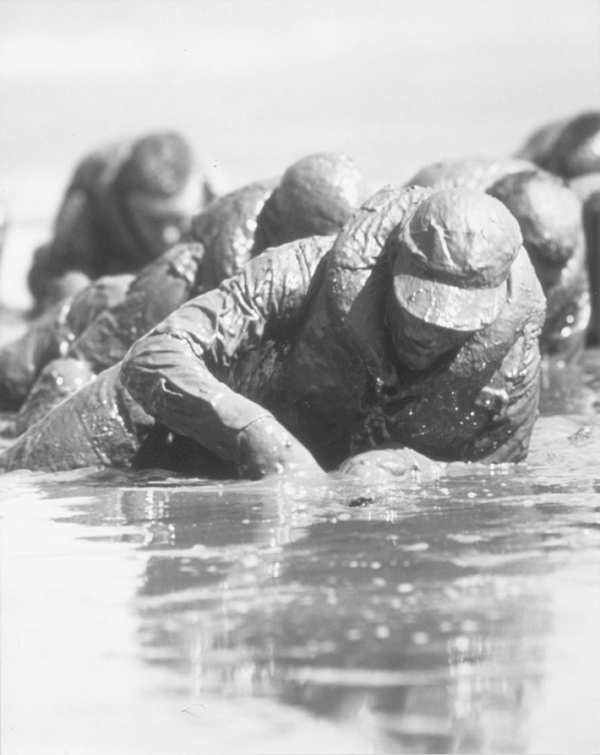
Chapter 5
A New Deal as a SEAL
SEAL training for Corpsmen during Vietnam
was separate but equal to BUD/S.
—US Navy—
As it turned out, I was only partially right about the SEALs. They were much more than the Underwater Demolition Teams that spawned them. The original UDTs, created during World War II, were used to help clear and prepare the beaches for the D-Day invasion. Their primary focus was on underwater mapping and explosives. The SEALs, on the other hand, were designed to be a special-forces covert unit that could function not only in the sea, but from the air and on the land as well. The name comes from an anagram for Sea, Air, and Land.
I didn’t know it when I volunteered, but the SEALs were considered the most ruthless and efficient of all the American Special Forces. Officially commissioned in 1962 by President Kennedy, SEAL Teams began as a detachment that could infiltrate enemy territory in small groups. While the Teams, as they were often called, were primarily designed to specialize in maritime and riverine environments, they were actually expected to be able to function in any environment, to be used to conduct clandestine and counterguerrilla operations wherever and whenever such operations were needed.
I also didn’t realize that the physical requirements for the SEALs were considered the toughest in the U.S. Military. Even though I had already passed the Marine elite forces training program, and proven my abilities during three months in ’Nam, I was still put through a grueling series of tests, both mental and physical. Fortunately, my training with 3rd Force Recon had toughened me even more than growing up in the Chicago area. I qualified without too much difficulty.
If I had not been a corpsman, I would have been sent on to BUD/S, or Basic Underwater Demolition /SEALS, training. But in 1968, corpsmen could not receive the regular course of instruction, especially in demolitions. That policy came to haunt me later. BUD/S was the grueling meat grinder course that separated the men who would be SEALs from everyone else. It culminated with Hell Week, five and a half days of constant physical and mental punishment with only an average of twenty minutes of sleep each day. The program is designed to break those who can be broken. During the early days of the program when someone decided that medics should not be allowed to have this training they did not think about the fact that medics have to face the same enemy under the same conditions as the rest of the team. I knew nothing of that. I just knew that I was being sent on to a new program called Special Operations Technician in Key West, Florida, along with about seventeen other corpsmen.
I drove down from Chicago to Highway 1 and reached the Florida Keys on a hot muggy Sunday in August. Key West is located at the farthest tip of the group of islands that make up the Florida Keys. As the southernmost city is the U.S. it is actually closer to Cuba than to the rest of the U.S. Mainland. The islands of the Keys are joined together by a series of bridges and ferries and connected by Highway 1. As I drove its length, I noticed that the highway was never more than a few hundred yards away from the waters of either the Gulf of Mexico or the Atlantic Ocean. Some of the Keys were so narrow that I could see both at the same time. A breeze blew off the waters, but the heat and humidity insured that the breeze did nothing to cool the air. Pale pink, aqua, blue, and beige buildings dotted the two-lane roadway, most of them decorated with garish signs advertising all manner of souvenirs from shells and T-shirts to sea monsters.
I passed a multitude of bathers and boaters enjoying the water in these last days of summer. Fishermen often sat along the edge of the bridges or on boats pulled up beneath them. I remember looking at the blue-green waters and thinking how great it would be to take a cooling swim. It was the last time I would ever look forward to getting into those waters.
I found the Naval Base easily once I reached Key West. It was situated right off the Highway along the shoreline. Like most military installations, the Key West Naval Base was filled with barren, no-nonsense, blocky buildings designed for efficiency rather than style. Unlike most bases, these buildings were all thick-walled and painted in white or pale hues. Fortunately, none of them were aqua or pink. The grounds were neatly kept with well-manicured green lawns accented by the occasional yucca plant and palm tree. A thick growth of mangrove trees formed a forest along the shallower edges of the shoreline, partially obscuring a clear view of the Gulf.
My uniform shirt stuck to my back as I unloaded my gear from the car and attempted to get my bearings. I finally located the U.S. Navy Underwater Swimmers School, marked with a small makeshift sign on a wooden post imbedded in the lawn and a statue of a frogman riding a shark. Lugging my gear inside, I was grateful to find that the thick walls blunted the effect of the heat. Two formidable men in blue and gold T-shirts and khaki swim trunks, who I assumed to be instructors, stood near a table at the far end of the reception area. Some others were talking to younger men who had to be newly arrived corpsmen like me. Dick Wolfe, a big, tough redheaded corpsman I had met earlier, came in behind me and hovered at the door. Like me, Dick had served with a Marine Recon unit and survived to tell about it. We had developed a friendly but competitive relationship. Determined to be first to the plate, I stepped up to the “Quarterdeck”, so called because it was the main “deck” or reception area of a Navy command, and cheerfully greeted my hosts.
“Hey, guys. I’m here to check in.”
The man closest to me approached with a disdainful expression on his face. I guessed him to be in his early forties from the grey that streaked his close-cropped hair, but he was powerfully built and very fit despite his age. With hands on hips he managed to tower over me even though I was probably at least as tall as he was.
“Gimme fifty!”
I just got here and they’re already gouging me! I thought, as I dug around in my pockets.
“All I’ve got is two twenties and a ten.” I pulled the money out of my pocket and handed it to him. “Here. Can I check in now?”
The room erupted with laughter as all the instructors doubled over and pointed at me. My face flushed as I suddenly realized my mistake and reached out to retrieve my money, but the instructor neatly evaded my grasp.
“Now drop and give me fifty pushups,” he commanded as he pocketed the money.
“That’s no way to treat . . .” I started to complain.
“Pardon me!” He leaned forward so that he was yelling right in my face. “What are you trying to say? You puke! You ain’t gonna last. I’ll see to that. Now get down and give me fifty.”
As I dropped to the deck, I wondered what I had gotten myself into. There was no doubt that my training had begun, and round one had gone to the instructor. I soon learned that the rounds always went to the instructors. They were on our backs and chewing our tails from the moment we arrived. Dick thanked me later for taking point so that I was the fool instead of him.
The man who so neatly humiliated me was Joe Kazmar. He became my greatest enemy over the following month. I’ll always love that man. He was aided by Dick Ray, Roger Moscone, as well as other experienced SEAL instructors. Because of the special rule regarding corpsmen, their task was not an easy one. We couldn’t attend BUD/S, but were going to be working side by side with men who had. Because a team is only as strong as its weakest member, they had to find a way turn us into SEAL operators despite the rule. Joe and the others really had no experience in handling a rag-tag group of medics like us since we were the first group of Corpsmen to go through the new program. But they were experts in preparing SEALs. Following the old adage “stick with what you know,” they decided to treat us just like SEAL trainees and not worry about the fact that we were medics. To that end they put us through every kind of hell they could imagine—and they had very active imaginations. They seemed determined to insure that, just like at BUD/S, only the best would make it to graduation.
What followed was three weeks of the worst PT I had ever experienced. No one warned me that they were going to try to kill me before I went back to Vietnam. Out of the original seventeen, only five corpsmen, including Dick Wolfe and myself, lasted through the course. I wanted to walk away within the first week, but the instructors were determined to make me stick it out. I had already been to Vietnam, and had a good idea of what it took to survive there, so they were unwilling to drop me from the class. Every time I wanted to quit, they found something else for me to do.
I spent a lot of time in the water. It seemed we were always swimming, struggling to learn to handle inflatable boats in rugged surf and swift current, getting in the water, hanging in the water, or just crawling through the mud. When I wasn’t getting wet, I was doing sixteen-mile runs through the deep beach sand, or straining to hold up my part of a huge log high over my head for what seemed hours. I just knew the instructors spent their nights dreaming up new and innovative ways to cause us pain.
One of Joe Kazmar’s personal favorites among all his modes of torture was the water tread. He loved to make me swim in the cold water doing flutter kicks for hours. During these sessions my body became one giant, frozen ache as my legs worked furiously to keep me afloat. Somehow the seaweed always tangled around my legs—like some kind of sea monster—determined to pull me under. I was equally determined to stay afloat, but this was definitely not my idea of fun. I had a suspicion that if I ever went under, no one would bother to pull me out.
During one of these torture sessions when the ocean waters were particularly cold, I finally decided enough was enough. I had nothing to prove. I had already done ’Nam and saw no reason why I should continue to allow myself to be the victim of Joe’s sadistic nature.
“I quit!” I sputtered after fighting off a particularly determined patch of seaweed.
“Doc,” Joe leaned over the gunwale of his comfortable boat, so close I could smell the coffee on his breath. “You can’t quit.” He yelled, “We’ve already gotten rid of the rum-dumbs. We’re not going to let you quit.”
“But I said I quit!”
A slow, ferocious smile lit his face. “You can swim, or you can drown. But you can’t quit.”
Given those options, I decided he was right. I had to swim.
And that was how it went for weeks. By the time the first three weeks were up, the few of us who remained were getting in pretty good condition. At that time the newest class of UDTR students who had just completed their initial training at Little Creek, VA joined us. At first, they looked down on us because we were not “regular” SEAL trainees. But we had been run around, worked on, and pounded into the sand so much that we soon proved we could hold our own with any of them. Together we began the underwater phase of training.
SEALs are noted for their underwater skills, but up to this point, most of our training had been focused on how to survive on the surface. The world beneath the waves is an unforgiving and alien environment. To survive there, we had to learn how to be as comfortable in its cold embrace as we were on land. That required learning how to use Self Contained Underwater Breathing Apparatus, or SCUBA gear, as well as the more stealthy—and dangerous—self-contained re-breather units. As a medic, the studies of dive physiology, and all the nasty things that can happen to a human body when something goes wrong underwater, fascinated me. We spent many hours learning how to cope with all the multitude of equipment failures that can happen when you carry your life support on your back. Since most SEAL underwater operations are conducted at night or in low light conditions, we spent many hours learning how to navigate in water so dark you couldn’t see your buddy. I was usually cold and always wet, but if the seaweed monster attacked, at least I could now fight it on its own turf.
We finished scuba training in November. The UDTR students went back up to Little Creek for Demolitions training—barred to corpsmen—and the four of us who had survived continued on to Lakehurst, New Jersey for parachute training.
Jump school was something else. After all the grueling weeks in Key West I expected more of the same. Instead, we set a new record for getting our wings. Since there were just the four of us, we received an accelerated course of instruction. The normal three-week course was shortened to three days: one day of ground school, one static line jump, and then fourteen free falls. All the jumps were done within two days. On the fourth day we were jump qualified and were awarded the Navy gold wings to prove it. I was able to get home in time for Thanksgiving.
Despite the enforced separation from the regular SEAL trainees, our little band of medics actually managed to complete every aspect of basic SEAL training except Hell Week and demolitions, thanks to Joe and his fellow torturers. In my case, I felt I wasn’t missing anything. I had done my “Hell Week” for three months in ’Nam. And while I hadn’t learned how to make and deploy explosives, I knew how to help put the victims of those explosives back together. At the time, I thought it was a fair trade.