Chapter 7
The Right Stuff
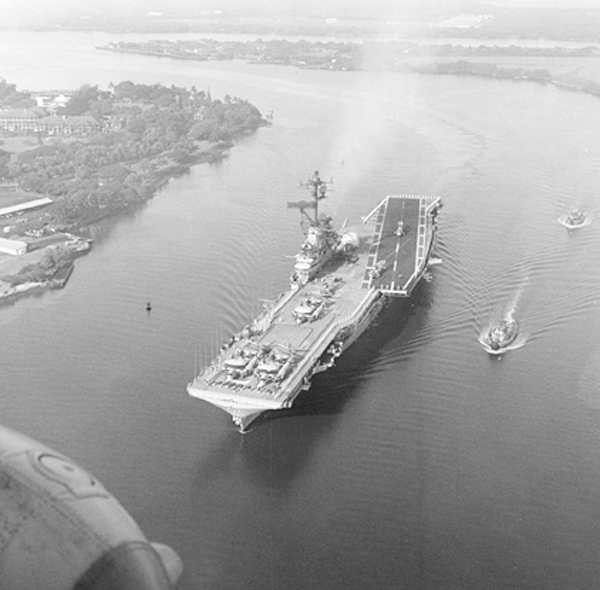
The U.S.S. Hornet served as recovery vessel
for both Apollo 11 and Apollo 12.
—National Archives photo (# 428-KN-18090).—
I didn’t get much time to reflect on my Independence Day performance before I found myself again practicing to jump out of an aircraft, this time without a parachute. By mid-July I was bobbing on the Pacific Ocean with the Apollo 11 capsule recovery team aboard the U.S.S. Hornet. We were waiting for Neal Armstrong, Edwin Aldrin, Jr. and Michael Collins to do their moon thing and come home. As the recovery divers, our job was to jump into the water once the spacecraft splashed down and secure and recover the capsule, its contents, and all its parachutes. It had become a tradition that every incoming space capsule that splashed down, since the Mercury program, was met in the water by UDT men.
Under the watchful eyes of the Hornet’s deck apes, we spent our days practicing the recovery maneuvers in the waters around the ship’s position. The ocean temperatures were mild—and teaming with sharks. At the time their presence didn’t really bother me. During almost every dive I saw their sleek, deadly shapes either cruising nearby, or hanging in the distance, their shadowy shapes barely visible against the deep blue. The movie Jaws did not yet exist, so it didn’t occur to me to be afraid of them. If Jaws had predated Apollo 11, it would have been a lot more difficult to get into that water. I would have been pointing out that sharks have been known to eat seals. But if these sharks liked seal meat, it wasn’t the sort spelled with capital letters. I ignored them and stuck to my business, and they did the same.
When we weren’t practicing the recovery, we joined the NASA boys on the hanger deck or up in the Ward Room going over the logistical details of the mission. Unlike the rest of the boat crew, who were regulation to the core, our team was very informal. We wore UDT trunks, blue and gold tee shirts, and coral booties as our everyday uniform. None of us, including Lt. Kenney wore any rank identifying insignias. Everyone just knew us as “the Frogmen.” For the most part, the crew of the Hornet treated us very well, but there were unfortunate exceptions.
One morning during a combined meeting that included our team, the Commanding Officer of the Hornet, and the NASA contingent, Lt. Kenny called me over to tell me that he had a sinus problem and couldn’t clear his ears. We had a practice dive scheduled for later that day, so this posed a potentially serious problem. If he could not clear his ears, he would not be able to equalize the pressure once he submerged below the surface and risked damaging or puncturing his eardrums. Fortunately the condition could be easily remedied with a decongestant and some antihistamine. The LT asked me, as his corpsman, to get him the needed meds. Sickbay was located just behind the Ward Room, so I ducked out of the meeting and into sickbay.
It was about 0930, and sick call had just ended. The ship’s chief corpsman, a pencil necked geek named Jones who didn’t look like he had ever seen a push-up, much less passed basic training, was just sending his last patient out the door when I arrived.
“Hey, Chief, can I get some Neosynephrine nasal spray and some Actifed tablets for my lieutenant?”
The Chief puffed up as if I had just asked him for his life savings. He looked me up and down, examining my trunks and tee shirt as if I was some kind of particularly obnoxious germ he had discovered under his microscope.
“Sick call is from 0600 to 0900. Come back tomorrow.”
“But he needs them now!”
“And just who the hell do you think you are? Coming into my sickbay dressed like that and asking for drugs? I’ll decide what meds to prescribe. I repeat: sick call is over.”
“Chief, I am a Special Operations Technician with UDT-11. As such, I am fully qualified to prescribe medication.” I attempted to maintain polite protocol despite the fact that this guy was getting to me.
“Oh yeah? What’s your rank?” His voice dripped with condescension.
“E-5. Why?”
“Well, then, junior, if you want meds for your lieutenant, I suggest you return during sick call like everyone else. And wear a uniform!”
“Up your ass Chief! I’ll just let the boss know he will have to wait until tomorrow to come and see you in person. You’re right; I’m probably just too junior to assess his illness. Funny thing, though, the government thinks I am old enough to be trusted with the astronauts!”
I was pissed, partially at myself for asking this jerk for anything. I had a whole supply of meds and equipment stowed down below in our Conex box along with all our dive gear. I was just being lazy because sickbay was so close and I didn’t feel like walking that far.
I went back into the Ward Room, still steaming and asked Lt. Kenney for the keys to the Conex box so I could get to my med supplies.
“I’m sorry LT” I said in a stage whisper loud enough for anyone in the room to overhear, “I tried to get meds from sickbay, but Chief Asshole over there says if you want meds you have to come and get ’em yourself—so long as you do it during sick call, that is.”
Lt. Kenney, always more of a gentleman than I, sighed in sympathy and retrieved the keys.
The CO, a no-nonsense kind of guy, must have overheard my tactfully phrased report and done some quick tail-chewing over his com, because before I could walk out of the Ward Room with the keys, the Chief Corpsman, with the ship’s head doctor in tow, appeared in the doorway “to check on my Mr. Kenney.” I watched the show as the doctor very solicitously examined his ears, nose, and throat. Lt. Kenney politely suffered through the exam while the much-cowed Chief hovered nearby. After a few moments, the doctor made his diagnosis and ordered the Chief to run back to sickbay for some Neosynephrine nasal spray and some Actifed tablets.
“Funny,” I muttered so only the LT could hear, “that’s exactly what I asked for earlier.”
Lt. Kenney rolled his eyes at me when they weren’t looking, but, with the true diplomacy of a born officer, thanked the doctor kindly for the meds and for giving his personal attention to the matter.
Despite this and other minor irritations, we were ready and eager on July 24th, when it came time for the Apollo 11 capsule to re-enter the atmosphere after its historic journey to the Moon. According to plan, the team was split into two recovery teams in two different helicopters. On splashdown the first unit would secure the capsule itself and see to the astronauts within. The secondary team would recover the parachutes which were expected to land some distance from the capsule. In true UDT fashion, we had all been trained to do both jobs. I was assigned to the secondary team, commanded by Lt. Kenney, with the recovery of the parachutes as our planned objective.
The winds were up that day, and I noticed the ocean swells were high as I joined the team in our helo, already wearing most of my gear and carrying my fins.
“Rough seas.” Lt. Kenney warned us, signaling the pilots as he, too climbed in. I re-checked my gear as we flew approximately 12 miles downrange from the U.S.S. Hornet, to the spot where the NASA folks had determined that the parachutes would fall. The other helicopter remained with the Hornet, where the main capsule was expected to splashdown. As we hovered on station, I peered into the sky and waited, hoping to see something of the capsule before it fell out of our area.
I ended up getting a better look than expected. When the Apollo 11 broke through the atmosphere and the chutes opened, the capsule dropped 12 miles south of the Hornet—approximately where NASA thought the chutes would end up—and almost on top of us. As soon as the trajectory was confirmed, we became the primary capsule team, and received the green light to go in upon splashdown.
I gathered my fins, did a final check of my gear, and looked up in time to see the capsule hit the water. The pilots moved right up to the capsule’s location, then dropped down as close to the water as they dared and held steady. Lt. Kenney stepped to the door, and jumped in. I prepared to follow. With the waves swelling fifteen to twenty feet, I knew it was important to time our jump to land at the high point of the swell. We had practiced this maneuver, and usually only fell 5 or 10 feet before hitting the water and popping to the surface. I watched the ocean rise up, fall away suddenly, and rise up again. I clutched my fins and jumped.
I fell the expected 10 feet—and kept falling for another 15 or 25 more before hitting the water. Hard. I realized that I must have missed the swell and hit a deep trough. The impact from that height plus the weight of my gear carried me deep under the waves. At that depth, instead of rising back to the surface, I just kept sinking. I knew the compression from the increasing water pressure would continue to pull me down if I didn’t do something to increase my buoyancy. I pulled the emergency CO cartridge to inflate one of my UDT life vest and immediately popped to the surface. I could see the capsule drifting away from me, so I quickly put on my fins and swam hard to catch it. The distance refused to close. The current pulled the capsule away faster than I could swim. Determined to catch it, I put on an extra burst of speed and finally managed to grab hold of the spacecraft. I looked around and was gratified to see that the rest of the team had also reached the craft.
Only when we all reached the capsule did the true historical significance began to sink in. Wow, the first guys ever to set foot on the Moon are actually in that thing! And here I am, a 20-year-old Navy frogman, and I’m part of the recovery team! I could see by the expressions on the guys’ faces that most of them were having similar thoughts.
But we had work to do. With the others, I set about securing the capsule just as we had practiced so many times. The procedure went smoothly, just as practiced with the rehearsal craft—except this capsule was not clean and shiny like the rehearsal craft. She bore blackened scars from the heat of re-entry, deep pits from space-born debris, and smelled like burned rubber.
Our first task was to secure the large orange floatation collar around the capsule. The collar kept the heavy metal capsule from sinking and also stabilized it a little bit so the astronauts would not get seasick. They had been weightless in space for a long time, and dropping into a wildly tossing ocean wouldn’t do much to quiet their stomachs. We had to steady the craft quickly or it wouldn’t take long for three astronauts to start hurling Tang.
Once the collar was in place, I set about my assigned task: communicating with the astronauts to ascertain if everyone was okay. I moved over to the hatch and tapped the glass porthole with my K-bar’s knife handle. Michael Collins appeared at the hatch and gave me the thumbs up sign, then did it twice more. Three times meant all of them were okay. I relayed that fact to the hovering helicopter so that they could send the good news back to the Hornet. We then waited, hatch still tightly sealed, while the astronauts put on their bio-suits to protect against possible contamination from any moon germs. NASA worried a lot about moon germs, so the astronauts had to stay sealed in bio-suits until they were decontaminated. Once they were ready, they blew the explosive release bolts on the hatch and I swung open the door. A fetid stench rose from the aperture, taking me by surprise, causing me to gag. Boy, did it stink!
“Good Grief! Who had the extra jalapenos?”
Michael Collins laughed and awkwardly climbed through the open hatchway. As I guided him onto a small life raft tethered to the capsule, I thought about the fact that Michael went all that way, but never did get to land on the Moon. He had to fly the orbiter while Aldrin and Armstrong rode down to the Moon’s surface in the Eagle. Once on the raft, I helped him into the specially designed hoist cage and watched as he was lifted up to the helicopter above.
Next Edwin Aldrin climbed out, to be lifted into the helo, followed by Commander Neil Armstrong. After I helped Commander Armstrong onto the hoist, I peered through the mask on his headgear and noticed that he appeared in good spirits. He looked at me and smiled.
“Welcome back safely, sir!” I yelled over the wind from the rotor wash, and snapped a crisp salute. He, in return, mouthed a thank you and gave me a thumbs-up sign. After he was hoisted onto the helicopter, I thought Wow. I’ve just had the first conversation with the first man to walk on the Moon!
We got the capsule back to the U.S.S. Hornet and secured it on board, but because we had been exposed to both the astronauts and the interior of the capsule, we were ourselves lifted aboard another helicopter and put in quarantine. The NASA doctors wanted to be certain we didn’t have any of those pesky moon germs. Of course, I knew more than they did, and declared us all healthy after a couple of hours, long before the official okay.
Later, after all the congratulatory speeches were done, we watched the replay of our splashdown recovery as it had appeared on television. When it came to the part where the hatch was opened, I saw myself speaking to the astronauts.
“Hey, Doc, What’s that you’re saying?” Chief Jones asked
“When?”
“Right there. As the hatch was opened.”
“Uh, I’m not sure, Chief”. I lied, “I think it was something like, ‘We are from the government, and we are here to help you.’”
On July 29th, while the rest of the recovery team was basking in the limelight, I quietly flew off the Hornet to join my platoon, already in preparation for deployment to Vietnam.
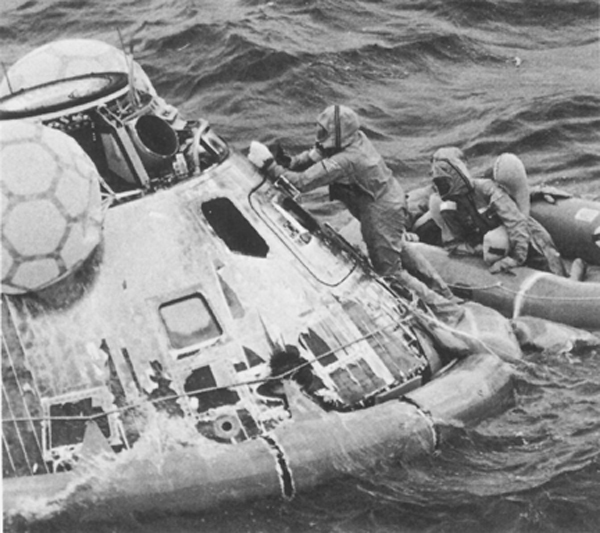
All the Apollo 11 recovery swimmers wore protective masks and coveralls
while securing the Apollo capsule because of concerns
of contamination from the moon’s surface.
—US NAVY National Archives—