Chapter 4
Presidential Peculiarities
We sometimes lose sight of the fact, perhaps because we would prefer not to think about it, that presidents are also people with all the flaws and eccentricities that entails. Much of what follows says a lot about the presidents as people. Then again, several entries are here because they are just too much fun not to pass on.
Dignity, Always Dignity
There is no question that John Quincy Adams was among the most dignified and eloquent men ever to serve as president. He was also the victim of perhaps the first outright theft and certainly one of the most embarrassing thefts in presidential history. The story is that the sixth president was also an athlete in the style of Teddy Roosevelt. Among his exercise regimes was to walk from the White House early every morning and swim in the Potomac River. (It was a lot less polluted in those days.) When doing this, he simply took off his clothes and dived in. Since this was long before the days when there was a Secret Service, or any other bodyguards, the clothes sat unattended on the riverbank. Someone out walking found the fine clothes and money on the bank and helped himself. The result was, at the end of his swim, the president of the United States was bare naked and alone. To retain what dignity he had left, Adams retreated back into the water. When a young boy walked past with a fishing pole, he convinced the lad to run to the White House and tell the First Lady to bring him some clothes. There is no record of what the lad thought about this errand and who it was for.
The Big Block of Cheese
There is an episode of The West Wing where the chief of staff, Leo McGarry, gives what they call his “big block of cheese speech.” The fictional character talks about how Andrew Jackson not only had an open-door policy but also kept a big block of cheese in the foyer of the White House for visitors to nibble on. The real story is even more bizarre.
It was toward the end of Jackson’s term in office. He was quite popular with the farmers and rural voters. Some of the wealthier ones decided to reward Jackson for a job well done with a wagon-size block of cheese, estimated to weigh about fourteen hundred pounds. With only a few months left in office, Jackson realized that this generous gift was a bit of overkill. He could eat more than twenty pounds of cheese a day and there still would be some when he left the White House. So the egalitarian president announced, just as the TV story went, that anyone visiting could have a piece of cheese. The trouble came because Andrew Jackson was not very easy to get along with and had, as president, made a lot of enemies in town. When they heard about his generous offer, they decided to spoil the gesture. Through word of mouth the invitation for free cheese spread quickly and the next day the lobby of the White House had what was probably the first, and only, politically motivated cheese riot in the august building’s history. Several thousand people lined up and pushed into the building. Some carried knives and plates and most cheerfully dug out a piece of cheese with their hands. The crush was so great that Andrew Jackson was forced against a wall. When the rush subsided a few hours later and the doors were closed, Jackson was likely pleased to see that there was still more than enough cheese left for his use.
Closing the Open Door
For more than a century the door to the White House had been open to anyone who wished to make an appointment to see the president. Every weekday at 12:30, the line of often several hundred people would begin walking though the office of the last president to honor this tradition, Calvin Coolidge. It is strange that the often abrupt and short-spoken president was the final one to observe the custom, but he made a great effort to be present at the meetings, though he often lamented the long-winded nature of his guests. Herbert Hoover ended the practice when he took office in 1929.
Feel Good President
Though, personally, James Monroe was not at all a “feel good” type, his administration benefited from two major trends. The first was the heady feeling that the new nation had stood up to Britain and held its own. It is hard to calculate just how much this added to the sense of national identity, but it established the national optimism that led to Manifest Destiny and the expansion across to the Pacific. The second factor was the economy was booming. Not everything was sweetness and light, there was the 1819 recession scare and some scandals, but the sense that the United States had come of age as a nation changed history.
Good Preparation
Most of the first presidents went to school at the best universities. Then along came Andrew Jackson. He sprang from an area on the border between the Carolinas that was literally dirt poor. Most of those living in this Waxhaws region were farmers making a living on marginal, rocky land. No one had much money and there was a marked lack of schools. If anyone was trained instead at the school of hard knocks it was Andy Jackson. By the age of fourteen, Andy had already survived a bout of smallpox (yes, his face did have pock marks, but they got left off the portrait on the $20 bill). During the Revolution he had been captured by the British. Worse yet, his mother and two brothers were killed in the conflict. He then went on to become a renowned Indian fighter and to lead some of the toughest frontier men of his age, the Tennessee Riflemen. With such a rough and tumble background, he had little formal education. But it did prepare him for some of the nastiest and most vicious infighting possible: working with Congress. Jackson later studied law—let’s just say he was less than studious—and even served as a prosecutor in Tennessee.
Fair and Square
While John Quincy Adams accepted a fait accompli when General Andrew Jackson sort of accidentally took over Florida while chasing the Seminoles there, the record for biggest land grabber has to be James Polk. The eleventh president got elected by supporting statehood for Texas and this instilled a desire to grab even more Mexican land. As a result, when there was a border dispute over whether the Nueces River or the Rio Grande was the southern boundary of the new state, he ignored the evidence and insisted it be the Rio Grande. To enforce his decision, he sent the future president, General Zachary Taylor, with a large body of troops to “protect” the border. Once Taylor’s forces crossed the Nueces, they were attacked by Mexican troops, who saw them as invaders. Polk then pressured Congress to declare war on the grounds that American soldiers had been attacked on American soil. They did and, in the war that followed, not only did Polk’s government take the land between the Nueces River and the Rio Grande, but also lands that are now most of the states of New Mexico, Arizona, Colorado, Nevada, and California.
Anyone else notice a pattern? Jackson grabs Florida and later is president. Taylor leads another army and takes most of northern Mexico and soon he also becomes president. Maybe the best way to get elected is to invade Canada? Nah, some of ’em speak French.
Fire Fighters
Things were a bit more casual in Washington and presidents mixed more in everyday life. Two presidents personally helped to fight major fires while in office. The first was John Quincy Adams. The treasury building, not far down Pennsylvania Avenue from the White House, caught fire. Adams organized and directed the bucket brigade that helped fight the fire. When the Congressional Library was burning in 1851, Millard Fillmore joined in as a volunteer to help put out the blaze.
A side note is that this may have been the only time that Fillmore was more successful than Adams. The Treasury Building had to be replaced during the administration of Andrew Jackson, the next president. There was a good deal of dispute over where to put the new Treasury Building, even though plans were complete. Finally, President Jackson got disgusted, poked his cane in the ground, and instructed the workers to put the cornerstone at that location. Unlike Washington and Lincoln, he was not much of a surveyor. They built the new Treasury Building as and where instructed, but the location meant it intruded into Pennsylvania Avenue. Even today, the otherwise straight road is forced to curve around it.
The Adams Family
Charles Francis Adams was appointed by Abraham Lincoln as minister to France. It was a time of strained relations, as France was sympathetic to the Confederacy. Charles Adams was a good choice; there was quite a family tradition of holding this particular ministry. Charles’s father and grandfather had each also been minister to France, something often overlooked since his dad, John Quincy Adams, and his grandfather, John Adams, both went on to become president.
Hangman
There appears to be only one president who is officially recorded as having actually hanged a man. This was Grover Cleveland. The first office that the twice-elected president held was that of sheriff for Buffalo, New York. One of his duties involved presiding and pulling the lever at the hanging of a murderer. Rather than delegate this distasteful duty, Cleveland took it on himself. You have to suppose this means that the murderer also has the distinction of being the only person to be personally hanged by a future president, but he probably would have passed on the honor if asked.
Iceberg
In today’s media age you need to have a great personality to get elected. One errant sigh on national TV can cost you an election. This was not always the case. Few early voters actually had any direct contact with the president except to see him give a speech. Elected in 1889, Benjamin Harrison was the opposite of personable and appealing. In fact, Harrison was generally unpleasant to deal with. Mostly, though, he was unfeeling. His nickname was “The White House Iceberg” based upon the way that he treated nearly everyone. You do have to credit him for being consistent to the end. He even left his own children out of his will.
Marching Music
The reception line at many presidential events is quite long and often a strain for a busy president. Generally, at such events classical music is played by the Marine Band to lend an air of sophistication and harmony. Whenever President Teddy Roosevelt found the line too long, or had something else he needed to do, he would order the Marine Band to play instead a medley of marches. This invariably picked up the pace.
Washington Bull
While the image is amusing today, it is likely most people in 1841 hardly noticed when William Henry Harrison personally drove a cow, which he had just purchased, across the city to the White House. This was an era when most homes provided as much of their own food as possible and the White House was no exception. Since he discovered that they needed a cow, President Harrison went to the livestock market and purchased one. It was a Durham, and the farmer assisted the president in driving the cow through the main streets of Washington to the White House stables. Though he did not drive the animal through the streets, President Taft enjoyed fresh milk and in 1910 allowed a cow to pasture on the White House lawn. This seemed to surprise and amuse foreign dignitaries. There is still a lot of bull traveling through Washington, but this seems to be the last presidential cow to be famous.
Workaholic
President Grover Cleveland was a firm believer in the Protestant work ethic and, no matter what, endeavored to do each day’s work. This meant that on his wedding day he worked until almost 7 pm and then emerged for the wedding.
Kaiser Rolled
There is no question that Theodore Roosevelt immensely enjoyed his time at war with the Rough Riders. He often spoke of how he went hand-to-hand with a Spanish soldier and won. What is less known is that he came very close, and seemingly was quite willing, to start a war between the United States and Germany while he was president.
The reason behind this action is the Monroe Doctrine. Under President Monroe, with the support of the much more powerful Great Britain, the United States issued a doctrine that basically told the European nations to keep their hands off the Western Hemisphere. There were exceptions for areas already controlled, such as a number of Caribbean islands and the Guianas, but basically it stated no new incursions were going to be allowed. Almost a century later, the government of Germany was threatening to seize a large portion of Venezuela. The Germans had valid claims against the Venezuelan government, and the Kaiser was getting no satisfaction. The German emperor’s stated intention was to hold the lands to guarantee the payment of what was due. The reality was that Germany, having started late as a major European nation, was feeling the need to have a foreign empire like Britain, France, and even tiny Belgium. They were grabbing or had grabbed areas of Africa and the Pacific islands and had turned their attention to the Americas.
Teddy Roosevelt heard about the Kaiser’s intentions and called the German minister in. He stated that if the German emperor did not call off the invasion of Venezuela and accept arbitration, which he would kindly handle, the president would order Admiral Dewey to the Venezuelan coast to prevent any landings. That would be, in effect, a casus belli, a declaration of war between the United States and Germany. Roosevelt gave the Germans ten days to agree.
The minister was said to have been Teutonically outraged and insisted the Kaiser would never accept such a demand. Just to keep the pressure on, seven days later Teddy called the same ambassador in and changed the time limit from three more days to two more days. Again, the German ambassador sputtered and protested, but passed on the new deadline. With less than twelve hours left before Dewey sailed, the German ambassador appeared at the White House and briefly stated that the Kaiser had agreed to call off the troops and accept arbitration.
An even less well-known footnote was that, as a likely result of this confrontation, the German General Staff drew up plans for the German invasion of the United States. It called for a landing in New York City and the gradual expansion of the territory held along the East Coast. This today seems ludicrous, but at that time the German army was one of the largest and best in the world and the American army was small, badly equipped, trained mostly for fighting Native Americans, and reliant on state militias to fill out its ranks in the event of a major conflict. Had fifty thousand Germans actually landed, there is no question they could have taken New York City and a number of others. Also, the German fleet was at least as large and modern as the United States’ Great White Fleet. Fortunately, the Kaiser’s interests turned elsewhere and the German invasion never went beyond planning.
Twenty-Year Curse
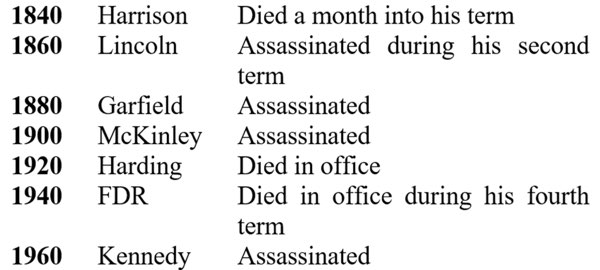
There has been talk of a twenty-year curse on the presidency. Almost everyone has heard that whoever is elected in a year that ends in a zero is doomed to an early death. The first presidents elected on the zero had no problems. Thomas Jefferson lived nineteen more years after leaving office and James Monroe another six years. The pattern seemed to have been broken by Franklin Roosevelt, who made it to his next term, being elected for a fourth time in 1944. But then he did die while still in office. Here are the fates of the presidents elected on the twenty-year periods from 1840 to 1960. Fortunately, Ronald Reagan seems to have broken the pattern for good, having been elected in 1980 and lived on many years after his presidency.
Bad Debt
As a side note, for no reason anyone now can determine, Congress stiffed the Elberon, NJ funeral director the considerable cost of Garfield’s funeral. But then, that was just one of three full-scale funerals held for the assassinated president. The bill remains unpaid to this day.
The Other Side of the Coin
When he was president, Theodore Roosevelt lobbied, unsuccessfully, to have “In God We Trust” removed from U.S. coins. Today we would attribute such an action to activist atheists. But TR’s reasons were just the opposite. He felt that having God on currency that was being used to pay for alcohol and even women was blasphemy.
Hangman
Abraham Lincoln is remembered as a man who defended minorities and preached mercy. This was often so, but he also approved the largest mass hanging in America’s history. The cause of this was an 1862 Sioux attack on settlements in Minnesota. The reason for this attack was that corrupt officials and the distractions of the Civil War meant that the Indians and their families were being literally starved to death. In reaction, they killed more than eight hundred men, women, and children. It took a unit of the Union Army to put down the virtual revolt, and more than three hundred Indians were captured. A military court tried all 307 captives and found them all guilty. Each and every one was condemned to be hanged. The sheer numbers involved attracted the president’s attention and he personally reviewed each of the 307 cases. In the end, he commuted all but thirty-eight of the sentences. The remaining captives were consigned to the noose. In front of four thousand spectators in Mankato, Minnesota, they were all hung. So, depending on your view, Abraham Lincoln either saved 269 from the gallows, or allowed the single largest hanging in history to be perpetrated on the starving Sioux.
Second Time Around
Of the forty-three presidents, Grover Cleveland has a particular distinction. He was both the twenty-second and the twenty-fourth president. Cleveland was first elected in 1884 and again in 1892, the term in between going to Benjamin Harrison. The second time was not a charm. While Cleveland’s “less is more” attitude towards government served him well during the relatively placid times of his first tenure, the second time things got more than a bit bad. The United States was hit by a massive depression and doing nothing served Cleveland about as well as it did Hoover forty years later—horribly. You would think Hoover might have studied his history and known better. At least now you do.
Strike Breaker
Cal Coolidge was no friend of labor. He often sided with the big companies. By 1923, when Harding died and Coolidge became president, he felt strongly that there had been more than enough reform legislation passed, and it was time for him as the new president to put an end to more. When once asked by Samuel Gompers, leader of the AFL, to help make sure that striking Boston Police officers be hired back, Coolidge replied “There is no right to strike against the public safety by anybody, anywhere, any time.” And Coolidge was not alone, as many in the United States felt that by 1924 the government had become unwieldy and top heavy, and the “he who governs least, governs best” attitude made Silent Cal popular. You have to wonder what he would make of today’s ungainly federal structure and bureaucracy.
First and Last
The marriage between Eleanor Roosevelt and FDR may never have been idyllic. Who is to blame can be debated. The first time the split became public was in 1918. In one of those “oh no” moments, Eleanor discovered the love letters that were still being written between Franklin and his mistress, one Lucy Mercer. She went off on the future president and even threatened to divorce him, which would have crippled his political career, if he did not stop seeing Lucy immediately. Just to make certain he straightened up, FDR’s mother, Sara, joined the argument with the threat to cut her son off from the family money if he didn’t clean up his act. The result of all this was two-fold. Firstly, FDR broke off with Lucy Mercer and soon replaced her with a new mistress. The second effect was the almost-total emotional alienation between Eleanor and Franklin. It is likely that from that point on the couple were never again physically close. FDR’s new mistress, Marguerite “Missy” LeHand, remained with him until she died in 1944. FDR then returned to the arms of Lucy Mercer, and was with her at the Calabogie Gardens resort in Georgia when he died. Knowing of Eleanor Roosevelt’s antipathy, all traces of Lucy’s presence had been removed before the grieving widow arrived.
Other Side of the Coin
Once the marriage between Eleanor and Franklin D. Roosevelt became loveless, both turned to others for companionship. Eleanor developed a very close relationship with a reporter named Lorena Hickok, who moved into the White House, into a bedroom directly across from that of the First Lady. It was well-known that they were both emotionally and physically close. But even though Lorena was herself a reporter, there was virtually no mention by any of the papers or radio commentators about the two women. Strange as it may seem to the modern reader, this was due to a gentleman’s agreement between presidents and press that kept such things out of the news until the new journalism of the sixties.
An S by Any Other Name
Due to a disagreement on what to name him, Harry S Truman had no middle name. All the records and his birth certificate have only the letter S. Eventually the dispute over which name the letter stood for was forgotten or ignored. No name was ever assigned to the letter and the S remained undefined all his life.
Air Force Fun
Before there was an Air Force One, President Truman had at his disposal a C4 fitted for travel. The name of this aircraft was Sacred Cow, which would be the name they used when contacting a tower. At one time, Truman was able to cajole the pilot into buzzing the White House. Trouble is, no one radioed ahead to warn the First Family or security staff of what they planned. The result was that when the large aircraft roared low over the building, his wife and daughter were rushed to a safe spot and the Air Force scrambled to intercept the plane they thought had been hijacked by assassins. Fortunately, the plane’s real occupants were made known before it was shot down.
Driving Miss, er, Somersby
While commanding the Allied Forces in Europe, General Eisenhower was constantly chauffeured around. He was assigned one driver, the very attractive Kay Somersby, whose driving and other skills he seems to have greatly appreciated. She became his permanent driver and by all accounts, including hers, also something much closer.
I Like Ike
Dwight Eisenhower was not the only Eisenhower child to go by the nickname “Ike,” though he was certainly the best known. Ike, it seems, was a sort of generic nickname used by the entire family, including his five brothers.
Enough Said
At least some of the stories about JFK and Marilyn Monroe were true. Also, according to her, you could throw in Bobby as well. Jealous?
Bestseller
The famous and still-selling book by John F. Kennedy, Profiles in Courage, was actually his second bestseller. A younger JFK turned his senior thesis into a book entitled While England Slept, which was a study of how Britain failed to prepare for World War II. The book was not exactly Pulitzer material, with factual errors and less-than-inspired writing. It was an instant bestseller, but only because his father bought thirty thousand copies that ended up in storage.
Mata Hurry
In the second year of his presidency, John Kennedy was involved for some months with Ellen Rometsch. She was the wife of the military attaché at the East German embassy. She was also one of the most expensive prostitutes serving the better class of clients in Washington, DC. It appears, not very surprisingly, that Ellen Rometsch was also working as a spy for the East Germans. When her espionage connection was discovered by Kennedy enemy J. Edgar Hoover, the State Department deported her so quickly that no one was able to question her about any of her high-placed customers, including the president.
Time Out
With all his energy, LBJ often had little patience for meetings he did not feel were productive. Loving technological gadgets, he wore a watch that also contained an alarm clock. In meetings, his alarm would go off and the president would hurry out. There were occasional suspicions that those alarms had been set by the president just minutes before going off.
Mono-Monograms
The entire Johnson family had the same initials, even the daughters. Lady Bird Johnson, Lyndon Baines Johnson, Lucy Baines Johnson, and Lynda Byrd Johnson. All were LBJs. Did the girls get to steal Daddy’s monogrammed shirts?
True Successor
LBJ was very much the successor of Jack Kennedy in a number of ways. It seems this president, too, was quite a womanizer. Lady Bird and Lyndon slept apart. Lyndon often did not sleep alone. He had two longtime mistresses. One affair lasted, non-exclusively, for twenty-one years. LBJ gave her cars and even a house. Another was a woman who shared his liberal views and bed for upwards of thirty years. But Johnson was almost always looking for a young, well-built conquest. If the president liked them enough, he even brought them back to Washington from Texas. The girls, often totally unqualified, were given make-work jobs during the day and performed their patriotic duty nights. LBJ was a philanderer, but not a complete cad. Once the president tired of one of these young women, he made sure they were sent to a new government position, but one that was far from the White House and his new companion. It seems likely that the hanky-panky was not limited to the presidential suite. Johnson had a buzzer installed in the Oval Office that gave warning when Lady Bird was approaching. If you were president, could you resist doing it there?
Tub King
Nixon acted like he was a king, but not the time he met “The King.” One of the most famous presidential photos is a shot of Nixon and Elvis Presley arm in arm and smiling broadly. Elvis collected badges and was there to get the president to give him one for the narcotics feds. To sweeten the offer, just before the photo he presented Richard Nixon with a gold-plated .45-caliber handgun. The ironies here are too many to list, but start with Elvis asking for a badge from the people who arrested drug users.
Gerald Ford Was Not a Klutz
When in college Gerald Ford played center on scholarship for the University of Michigan. He was not only a team leader but was also so good at football he was voted one year’s most valuable player. The many tales of his being a klutz began in almost a joking manner and took on lives of their own. Part of the reporting may have been a reflection of the dissatisfaction everyone felt when he pardoned Richard Nixon. Another part comes from the fact that President Ford still skied and practiced other sports with enthusiasm. But when he fell while skiing down an advanced slope it made the news. You have to wonder how many other people wiped out skiing that winter day.
Hunk
How about a president who, when young, was a state athlete and so good looking he was a model in a photo spread on “Beautiful People” for Look magazine and on the cover of Cosmopolitan? We had one—Gerald Ford.
Out There
While at a Lions Club meeting in 1969, the later-President Jimmy Carter and several others saw a UFO. Carter was sure enough of what he saw—a flying object as bright as that night’s moon which flew to within about a third of a mile of where he stood—that he sent in a written report. He is the only president to have reported a UFO. When elected there was some excitement among UFO buffs that he might expose the whole government “cover-up.” Why the thirty-ninth president did not was a matter of much speculation and disappointment. We are still waiting for our guided tours of Area 51.
Long Pass
Jimmy Carter liked his privacy and to get totally away from the job of being president when he returned home for a vacation. He was also very casual and often negative about things military, even though he was himself a naval veteran. Occasionally he took this attitude to a dangerous extreme. There was, and still is, a military officer who escorts the president with a device that resembles a football. That device is the only way the launch codes for nuclear missiles are released in the case of an attack. President Carter did not want the man carrying the launch codes to stay with or near him while he was home in Plains, Georgia. This meant that the football sat ten miles away in Americus, Georgia, every time Jimmy went home. Since the window for a successful retaliation to a Russian first strike was less than the almost fifteen minutes it would have taken to bring the codes to the president, let’s all be happy the Russians never pulled the trigger while Jimmy was on break.
Bad Tree
Ronald Reagan did really once state that trees caused eighty percent of the world’s pollution. He was quickly corrected and no trees were lost.
Star Power
When things feel out of control, people will look in the strangest places for security. Such was the case toward the end of the Reagan administration. Frightened by the assassination attempt on her husband, Nancy Reagan turned to an astrologer, Joan Quigley, for advice on keeping her husband safe. Very soon White House schedules, event times, even the time at which Air Force One would take off and land, were being dictated by the astrologer. Ms. Quigley’s star charts became a major factor in everything the president did. His chief of staff would often peruse the charts to determine when the president would be available to make crucial decisions.