Chapter Twenty
Chapter Twenty
I have stoked the fire on the big steel wheels,
Steered the airships right across the stars
The man’s name was Pangloss, and he was a steamliner pilot visiting Poseidon at the end of an airship run from the alchemy mines deep in the highlands of Atlantis. As the pilot, he called himself a commodore, although Owen could not determine who had actually given him that rank. Pangloss was entirely bald, lacking even eyebrows, but he made up for the dearth of hair on his head with a fury of black beard that spread across his chin and broad chest.
Commodore Pangloss helped Owen stumble from the alley to a clean and well-lit room in an inn several blocks from the tavern. “I have no great fondness for thieves, young man, and I would have walked by, assuming you were getting exactly what you deserved. I don’t know what stopped me. Maybe it was your appreciation for books.” He shook his head. “But I saw a look in your eyes, something there that I don’t usually see in hardened criminals.”
“I’m not a hardened criminal.” Owen spat blood and wiped his mouth, but he had no excuses to make. He wasn’t even sure if he was telling the truth.
Commodore Pangloss said, “Not yet, perhaps, but a city like Poseidon will ruin you soon enough.”
“I’ve got nowhere else to go.” Owen felt around in his mouth; one of his teeth was loose but didn’t wobble too much.
“You can share my room right now, but I head off again in two days,” the Commodore said. “Get cleaned up, and then I’ll hear what you have to say for yourself.”
It had been so long since Owen washed under bright lights, without fear of discovery, that he had forgotten what clean felt like. After he used soapy water from a basin and scrubbed his hands and face, rinsing away the dirt as well as drying blood, he saw that his skin was now no longer the color of grime and dirt. He sat wrapped in a blanket while the Commodore sent his filthy clothes to the innkeeper for a washing.
Owen ravenously ate some poppyseed rolls and cheese that Pangloss had left on a sideboard from his lunch, then he slurped a cup of lukewarm tea that felt like happiness pouring down his throat. He would have liked to add honey, but none was offered.
As a fugitive, Owen was hesitant to speak his name or admit that he came from Barrel Arbor. By now, the Regulators had surely broadcast an arrest warrant for him, though Poseidon City had no direct newsgraph connection to Albion. How much of a reward would the Watchmaker offer for his capture and return to face justice?
Magnusson’s Carnival Extravaganza had taught him that in order to earn his supper, he had to provide a show. And since he was too bruised and battered to put on a juggling performance, he settled for a story instead. Judging by his package of new books tied together in twine, the Commodore was an appreciator of tales.
Owen went on for more than an hour, and Pangloss listened without comment. Once he got started, the young man lost track of which details he should be hiding, and so he told it all, even about Francesca, and his time with Guerrero . . . and how his supposed friend had run, abandoning him to be beaten in the alley. Somewhere in the stories, tears began pouring down Owen’s cheeks, although he couldn’t say exactly which part had triggered them.
At the end, the Commodore said only, “I knew from my first glance at you in the bookshop that you didn’t belong here.”
“I prayed just to get away from Crown City,” Owen said. “With the Regulators chasing me and alarms all across the city, I looked at the cargo steamer ready to depart and thought of everything I had heard of Poseidon, the Seven Cities of Gold, the wonders of Atlantis. I knew everything would be better there. . . . I didn’t know it was all a lie.”
“Aye,” said Pangloss. “And everyone here has heard about the perfection of the Watchmaker’s Stability and the Clockwork Angels, that nothing ever goes wrong—everything has its place, and every place has its thing. It’s nice to have colorful stories that you can cling to like a blanket on a chilly evening.” His lips curved upward, though they remained overshadowed by his beard. “I can tell you that few people in Atlantis would want to be locked into the rigid schedules imposed by the Watchmaker, nor would we want uniformed Regulators inspecting every frivolous thing we might do. Even if we make unwise decisions, they’re ours to make, not someone else’s.”
Owen hunched over, pulled his blanket close, and groaned. Pangloss took pity on him. “You grew up in the Stability—I suppose you can’t be blamed for who you are. I didn’t originally come from here, but got . . . derailed from my own world. Nevertheless, I’ve made a good enough life for myself—mainly, I stay away from Poseidon as much as possible. A place like this will eat away at you soon enough.”
“Where else do you go?” Owen imagined that any place had to be better than the dark and dirty streets of the city.
“Aboard my steamliner, of course.” The Commodore smiled. “She’s a magnificent airship—flies free through the night and then alights on the rails and take us into each station along the mining route.” He heaved a sigh and spoke as if he were talking about a lover. “Not one of those lovely, bloated caravans that travels across Albion. She’s just a cargo liner—but she’s my ship regardless.”
Pangloss scratched his voluminous beard as if searching for a lost keepsake hidden among the strands, and he fell silent, pondering. Owen could see that the Commodore was a man who liked to consider his words before saying something he could not retract. “Rest up, eat up, and get yourself well, Owen Hardy from Barrel Arbor. I could use an assistant to help me stoke the fires and guide my steamliner. Ride with me for a while.”

The Commodore’s airship consisted of the locomotive dirigible and seven bulky cargo cars, each kept buoyant by tightly sewn canvas bags that swelled with hot steam piped in from the main boiler. The cargo cars were scuffed and dented, but clean. On his regular run, Pangloss hauled shipments of redfire opals, chalcedony, red coal, reactive ferrocerium, and kegs of rare alchemical powders excavated from the mountains. After delivering his cargo to Poseidon, he returned to the mountains with foodstuffs, clothing, tools, and equipment.
The main engine car also served as the Commodore’s traveling home. The pilot’s cabin smelled of oranges from the oil with which he polished the wooden furnishings. Owen stood before the controls that steered the airship when it was aloft and looked at the magnetic alignment compass that guided the steamliner back down to the rails for a landing.
The locomotive’s alchemical engine reminded him of a giant pet mastiff, powerful and growling but loyal to its owner. Also like a large mastiff, it needed to be fed regularly. Pangloss and Owen worked together, shoveling red coal and dumping barrels of sweet-smelling distillate of naphtha. The reaction was triggered by a catalyst of coldfire—premixed, packaged, and sold to Poseidon by the alchemist-priests of Crown City.
With Owen at his side learning the tasks, Commodore Pangloss spent two days loading his cargo cars with necessities for the mining villages on the steamliner route. Owen did additional chores like sweeping, scrubbing, and painting the cargo cars; he followed the Commodore around the warehouses and supply shops. He never caught a glimpse of Guerrero.
His muscles still ached from the beating. The bruises on his body—now plainly visible because he kept his skin clean—had turned alarming shades of purple and yellow, like something the carny clowns might have painted on themselves. Seeing Owen’s battered condition, some of the rough station yardworkers let out guttural chuckles, assuming Commodore Pangloss beat his apprentice. Offended by their attitude, Pangloss shook his nightstick at them, which only reinforced their assumptions.
Late one afternoon, when they were finally ready to set off, Owen’s excitement built like the pressure inside the steam boiler. He looked away from the cluttered city and thought about the mysterious continent, all the unexplored places inland. Somewhere in those mountains and deserts lay the legendary Seven Cities of Gold. Though gold itself had been devalued in Crown City, thanks to the Watchmaker’s alchemy, it could still purchase goods in Atlantis. Yet the wonder and mystery were the real treasure. . . .
They stoked the engines and sealed the boiler, turned the valves so that the pressure built up, filled the conduits, and inflated the zeppelin bags of the cars. The coldfire sparkled brighter in the containment chamber. The locomotive shuddered; the big steel wheels began to turn and spark, reminding Owen of the tiny flame sprites that Tomio had created as an alchemical trick for his birthday. So long ago . . .
The steamliner awakened and began to move forward. The parallel tracks that extended into the hills glowed a phosphorescent blue as the levitating train accelerated.
The Commodore stood on the pilot deck gazing through the front windows, intent on the rails ahead. Mountain silhouettes bit off the horizon, which was bathed in deepening colors of sunset.
“Go stoke the engines some more, Mr. Hardy,” the Commodore said. “We need to get up our steam, inflate all the sacks. We’re about to fly!”
Owen ran to add more red coal and reactive powders to the exothermic chamber. The locomotive engine puffed, growled, and bellowed like an animal declaring its territory. He ran back up to the piloting window and stood beside Pangloss as they hurtled along the rails.
The silver lines in front of them abruptly disappeared as the tracks ended.
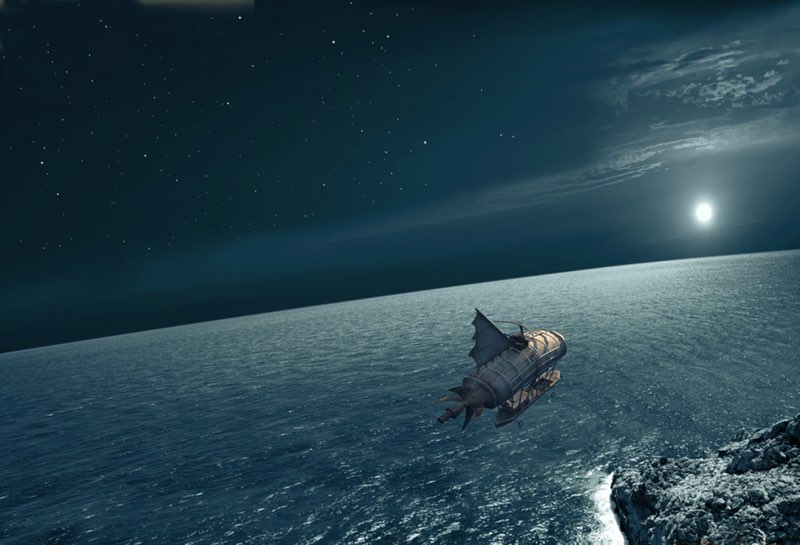
When the accelerating steamliner reached the end of the line, it leaped into the air as gracefully as Francesca. Instead of sprouting spring-loaded angel wings, though, the steamliner lifted off the ground and soared into the sky.
Commodore Pangloss stroked his beard as he stared ahead with a proud paternal smile. “Have you ever been on a steamliner before, Mr. Hardy?”
Owen took a moment to find his voice. “Yes, and no. Never like this.” He caught his breath. “Never anything like this.”
They continued ahead as night wrapped around them, smooth and quiet. The Commodore showed him how to find their course with the liquid-crystal compass, how to check the way the wind blew, how to keep them aligned on the proper vector so they could find the destination rails again when it came time to land.
Owen steered the airship right across the stars, and they flew by night into the mountains.