Interlude
Interlude
The Anarchist
The things I’ve always been denied
An early promise that somehow died
Wearing a well-tailored suit and carrying his leather valise, the Anarchist made his way toward the Alchemy College. He had more than his share of vendettas, for he was an ambitious man. So many people had wronged him that it was a challenge just to keep track of the list.
Most of all, he wanted to punish the great, yet flawed, Watchmaker—that much went without saying. Also, he had never forgiven the carnival, especially Tomio. He could have made the carnival show so spectacular, if only their imaginations had been greater than their fears—breathtaking alchemical reactions igniting in a blaze like a thousand bonfires, converting base powders, rare earths, and a chain reaction of catalysts! Through the transformative ignition of powders, he would have showered the audience with sparkling, new-formed diamonds, precipitate gems that even the Watchmaker could not create! Transmuting cheap metals into gold was a mere parlor trick by comparison. Yes, the reaction was as dangerous as it was spectacular, but what was life without risk? Tomio had driven him out, just like those small-minded philosopher-professors, had insisted that he was being too brash and reckless, that he was showing off.
No one understood him. He did not need to show off for the crowds, since his greatness was inherent. Even the Watchmaker had spotted his talent back at the Alchemy College. And when the student had become too talented, the Watchmaker set out to destroy him.
But after being expelled, he had survived, and thrived, and changed. The Anarchist glanced down at the alchemical symbol on his hand. He was a precipitate, a new being, created by a set of reactions. He flexed his other hand, the scarred one, felt a twinge of blind pain that went as deep as the bone. Such fire could change a person and change a civilization.
The Anarchist sought to create a new world order, an Instability that ran counter to the Watchmaker’s repressive Stability. He did it for the good of the human race, not just for revenge . . . although revenge had to be satisfied as well.
He had already left his mark by scrambling clocks in the city, turning the sedate march of time into a drunkard’s walk. That had shaken the everyday people from their deep slumber, though it did not entirely awaken them. He could count the stunt as one little victory, but it was not sufficient to end the war. In the grandest spectacle of all, he had attempted to destroy the coldfire nexus beneath Chronos Square, along with the Watchmaker’s tower and the Clockwork Angels—a setback that would have brought down civilization in Albion.
As he strode down the street, eyes fixed forward, he drew in a deep breath. The resulting chaos would have been its own reward, a dash of cold water or a bracing shot of whiskey! The turmoil would strengthen human hearts and minds, cure them of the deadly effects of apathy and atrophy, stability and stagnation. His neat and efficient vengeance would have hurt all those who had harmed him—the Watchmaker, the carnival, and the populace of sheep.
Every piece in its place, every action leading to a reaction. Like clockwork. Only he understood the irony.
Even such a neat plan was not without its risks, however. When naïve and innocent Owen Hardy (his unwitting protégé) had discovered the plot—not entirely by accident—the Anarchist had been content to turn to his secondary plan. A man like him had to embrace random acts.
He was alone—always alone. Yes, with so much work to do, he longed for an apprentice. He needed someone, anyone, to help his fight. He could not be the only person in all of Albion with the acuity to recognize the flaws of Stability. And if he could make even a small, insignificant, normal man see what the whole world lacked, then the battle was half won.
By tossing the detonator to the young scapegoat, he had set the wheels in motion, giving Owen another sharp shove toward his destiny, an alchemical reaction that might precipitate another Anarchist, someone against whom the world had unjustly turned. The mob and the Regulators had pursued him, howling for blood.
Owen Hardy had the potential to be an important catalyst, but he needed to be awakened. Optimism was such an insidious venom that it left a person too cheerful to know he had been poisoned. The young man was now awake, although not ready. Not yet . . . but the Anarchist had faith in entropy.
Eventually, experience would shape the young man into an ally.
That had been three days ago. Owen Hardy was gone, fled across the sea and out of the Anarchist’s reach—for now—but he would be back. Or the Anarchist would find another candidate. And there were always the Wreckers.
Today’s demonstration might wake someone else among the sheep. . . .
Now, as the Anarchist reached the huddled buildings of the Alchemy College, he found a quiet alley, opened his valise, removed his disguise. Before he could pass through the school gates, he had to become someone else entirely.
He shucked out of his business clothes and donned a traditional white robe adorned with alchemical symbols. He tugged a conical hat onto his head, tied the robe with a green sash that denoted his rank as a mid-level official alchemist from the Watchmaker’s headquarters, a person with sufficient authority to go where he liked, but not impressive enough to attract too much attention.
The Anarchist pulled the other part of himself inside, stuffed his real thoughts and feelings out of sight, and arranged his expression to match the rest of his disguise. He arched his significant eyebrows, twisted his lips in a haughty, critical air, and walked with a mean stride to the school’s cut-stone gates.
From years ago, he knew the schedule of classes and study times, and he knew they would never change. Timekeeping was the hobgoblin of little minds, and every person here was completely predictable. Like honeybees. He walked up to the school at the precise time when his work could have the most impact.
While studying at the Alchemy College, he had done such great work that the philosopher-professors were at first impressed, then intimidated. When he remained persistent, proposing ideas for unorthodox experiments that were not part of the curriculum, they had reprimanded him.
But he had drawn the secret attention of someone far superior to their closed minds and small dreams. He discovered mysterious, unsigned notes smuggled into his books and under his pillow in the dormitory—quiet encouragement, suggestions of possible chemical mixtures for him to try, questions that even the philosophy-professors or the alchemist-priests could not answer. And he knew the secret communications came from the Watchmaker himself.
More than a century ago, that man had rewritten the economy of Albion when he’d discovered how to create gold. The alchemist-priests who created and maintained the coldfire nexus beneath Crown City had long since stopped making new discoveries. No one else had the imagination even to try. The Watchmaker surely must be frustrated, needing fresh blood and new ideas.
He had continued to send surreptitious suggestions to that ambitious and talented student. In all his years of continuing research, the Watchmaker was never able to create diamonds or precision jewels; instead, he had to purchase them at a dear price from the mines in far-off Atlantis. So, he had coaxed the talented student to concoct an unauthorized experiment. If successful, it should have created a wealth of gems; instead, it had resulted in a massive explosion, one that burned and disfigured his hand, earned him severe reprimands and expulsion from the school.
None of the philosopher-professors believed him when he claimed that the Watchmaker was a catalyst for his experiments. They laughed at the very idea. They called him insane. They insisted that the Watchmaker did not communicate directly with everyday people, that he had no contact whatsoever with mere students.
Only later did he realize that the Watchmaker was so intimidated by his protégé’s talent and potential that the experiment itself had been sabotaged. . . .
Now, wrapped in his own physical and mental disguise, the Anarchist tightened the green sash holding his robe together and presented himself at the college gates. The red-uniformed Regulator glanced at his outfit and rank and allowed him through without question.
“All is for the best,” the Anarchist muttered, and the guard acknowledged him.
At half past the hour, classes ended, doors opened, and alchemy students marched out of their lecture halls to the assigned study chambers where they would memorize alchemical symbols, copy down approved reactions, and complete the designated tasks they needed to finish before they could be certified for the next level of study.
As he looked at them now, the students reminded him of himself. Years ago, when he was one of them, he had worn the same uniform every day. He had read the same texts, heard the same lectures, mouthed the same rote responses. The philosopher-professors wanted him to think like a scientist, and yet accept every discovery without question. The Alchemy College was designed to unlock the secrets of the universe; instead, without allowing the students to think for themselves, the classes did nothing more than reinforce ignorance.
Well and truly blessed, indeed.
The students gave the Anarchist respectful bows as they passed, making way for him to continue down the halls. Seeing his stolen robe, they were impressed by him, wanted to be him after they graduated. If only . . .
He walked without hesitation to the guarded chemical storage vault. A gold disk emblazoned with the familiar stylized honeybee had been affixed to its exterior. Hydraulic tubes ran to pistons that pressed long locking pins into the floor and ceiling, with crossbars thrust into sockets in the jamb. Large-diameter gears connected to one another in a special combination, metal teeth biting into the locking pins. A pad glowed with blue coldfire, waiting for someone to input the proper code.
Even with all the intertwined security systems, a Red Watchman also stood straight-backed at the door, arms at his side, gaze forward. The Anarchist walked up to him, impatient to see someone standing in his way. He ran his gaze across the red uniform, deliberately looking for the rank insignia.
“Lieutenant, I require access to the vault. The Watchmaker suspects irregularities in the accounting of certain rare earths and precision jewels imported from the Atlantis mines. I am here to complete a full inventory on his behalf.”
Noting the alchemist-priest’s robe and the green rank sash, the Regulator fished out a key from a ring on his belt. He inserted the key into the control pad, which made the coldfire glow brighter. He twisted a valve to release steam, making the gears turn; teeth retracted the locking pins from floor and ceiling; another system withdrew the side bars. Finally, with a hiss of equalizing pressure, the heavy vault door unsealed and swung inside with the force of heavy pistons.
The Red Watchman stepped aside to let him enter. “Do you require my assistance?”
The Anarchist gave a sharp shake of his head. “That is expressly forbidden. The Watchmaker assigned me alone to perform this task—undisturbed.” He glanced down the hall, where clocks were mounted every twenty paces. “Leave me for an hour. I will secure the door when I have finished.”
Reluctant to abandon his post, but more reluctant to question the Watchmaker’s instructions, the red-jacketed guard marched off like a windup soldier.
Inside the large vault, the Anarchist drew a breath filled with secrets. The chamber was lit by the eerie glow of floating coldfire globes, and he paused a moment just to drink it all in. He had been in the alchemy vault only once during his first year as an acolyte, when he’d assisted his philosopher-professor in organizing the treasures and dangerous supplies that crowded the shelves.
He had seen so much more since then. After being expelled from the Alchemy College, severely burned in body and soul, he had fled across the sea, worked like a slave, and nearly starved. But he went where he wanted, learned what he wished, and discovered that there were ways of life other than the Watchmaker’s Stability, other lands and other cultures beyond Albion. More than that, according to an eccentric bookseller who owned a shop in a back alley of Poseidon City, there were other possible worlds as well, not just this one.
The bookseller was a very tall, lean woman with short gray-brown hair in a mass of chaotic curls. She wore a pair of spectacles that left angry red pinch marks on her nose. On the dusty shelves in her dim shop, she carried arcane volumes in many languages, including treatises from scientists both great and obscure.
Back during his days of exile from Albion, the Anarchist had spent afternoons in the shop perusing the volumes until the bookseller scolded him to buy the tomes if he wanted to study them. “I respect a seeker of knowledge,” she had said, “but I am not a library.” So, he stole enough money to buy the books that most intrigued him.
The bookseller told him that they came from other earths, worlds where the laws of physics and chemistry might be different than here, that their conclusions might not be valid everywhere, but he didn’t listen to her warning. With such a wealth of knowledge, he was sure he could recreate powerful but forgotten discoveries. Preparing for a triumphant return, he stowed away aboard a ship bound for Albion; he smuggled not only the books but also rare and necessary alchemical resources from Atlantis. He returned to the land of the Watchmaker not as a prodigal son, but as a vengeful one.
The stern bookseller had been right, though. When he arrived at Crown City and practiced his demonstrations, the resulting chemical reactions were different from what the book told him to expect. Many of the Anarchist’s “triumphant demonstrations” were sad failures; one disaster resulted in two deaths, which forced him to change his identity and hide among the people. He had intended to create diamonds with his experiments, but the accidental discovery of such amazingly explosive chemical reactions served him in a different stead.
If the Watchmaker used his destiny calculators to see everything, did he know that the Anarchist had returned, the nemesis that he himself had created? Or were his own actions too random to be predicted?
Now, inside the alchemical vault, he found the powders he needed, the boxes of elemental salts, sealed beakers of acids, humours of green sulphur, and rare ingredients shipped at great expense from the continent across the sea: powdered dreamstones, distillate of red coal, oil of moonstone. Working like a chef preparing for a state banquet, he recreated his forbidden experiment, but on a much larger scale.
This would be no mere exothermic reaction, but one that would ricochet like chain lightning among the volatile chemicals inside the vault—natrium, saltpeter, magnesium, wolfram, kalium. He stepped back as the mixture began to rumble, releasing a scarlet mist. Distillates leaked onto the floor in bubbling pools of poison, like chemical symbols of his rage.
And that was just the beginning.
On top of the mounded chemicals he placed a beaker of dissolved redfire opals, the final reactive component. Now he required absolute precision—which was all part of the grand joke on the Watchmaker.
From a pocket inside his white robe, the Anarchist removed a device of his own invention, a pocketwatch with a secondary timepiece attached, connected to thin activator rings and powered jointly by a wound-tight watchspring and a chemical battery. A detonator . . . a small thing, but sufficient to create a shock at the desired time to spill the beaker of dissolved redfire opals into the remaining chemical mixture. Flint and steel to liberate—beautiful word!—a spark. The energy slumbering within the elements would awaken with a roar.
As the detonator ticked, he turned to depart, not just taking his time but stealing it. Just inside the vault door, though, he spotted a complex, intriguing device on an equipment shelf, placed safely away from the chemicals. A newly tuned but inactive machine.
He had seen a destiny calculator only once before, but there it was! He caught his breath. This was a small device with a limited temporal range . . . but if he could set the needle to focus on a particular person, he would be able to monitor Owen Hardy’s future before the young man made it for himself. Then the Anarchist could make the proper adjustments, or at least put himself in the right places.
He carefully removed the destiny calculator from its storage shelf, held it in one hand, hid it by pulling down his padded sleeve, and hurried out of the vault. Behind him, the detonator continued its countdown.
As he left the chemical supply chamber, he reset the coldfire control pad so that the crossbars and locking pins snicked back into place; the hydraulics pressed the door into its seal; steam vented with a sigh of relief for a job well done. A last careful detail: he smashed the coldfire control pad, which sparked, sputtered, and died.
He had set the device for eight minutes, and the Red Watchman was due back in ten, but in such a random and exuberant experiment, one could not be precise.
Carrying the stolen destiny calculator, the Anarchist moved with a quick step down the college halls, past the closed doors where students were studying for their examinations. He kept his eye on the clocks, watching each second tick away, trying not to look hurried. Once outside the school buildings, he passed the Regulator guards at the entrance gate; they did not impede or even acknowledge his departure.
A long time ago, he had been driven from the Alchemy College, chased off the grounds. Now, he felt like a conquering hero.
He found his valise exactly where he’d left it in the alley—no one in Crown City would even think to steal. He shucked off his alchemist-priest’s robe and cap and donned the formal suit again, his well-dressed disguise. He stored the destiny calculator, straightened his hair, and reentered the streets, melting into the crowd just like everyone else, invisible and unnoticed. He had just enough time.
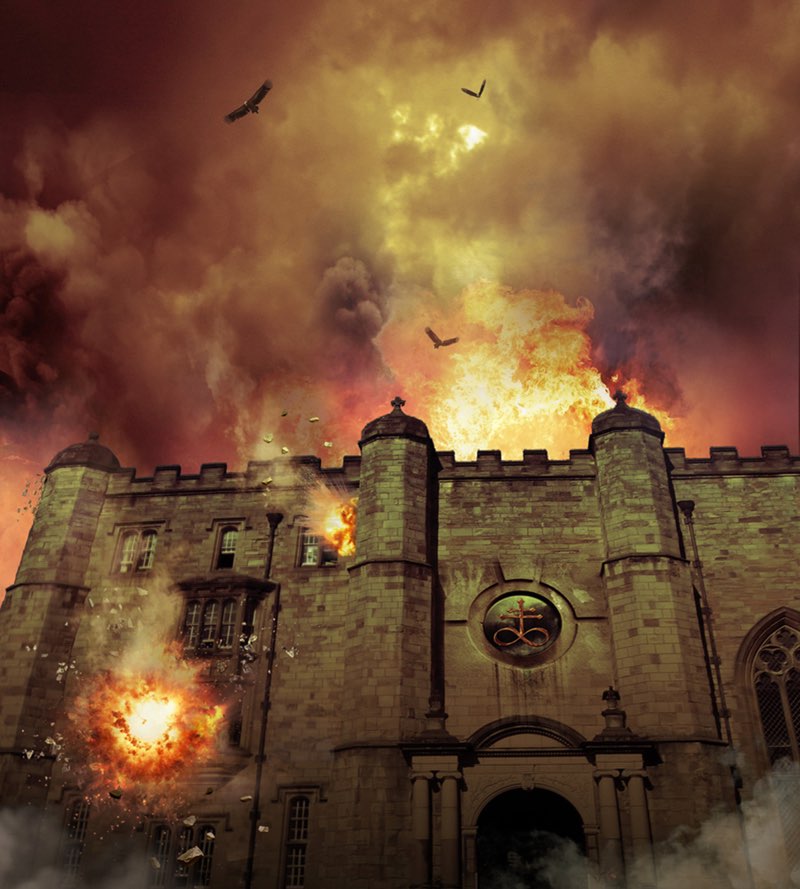
Behind him the Alchemy College exploded.
There were shouts and shrieks. People came running toward the smoke and flames, but he just smiled and walked on. He heard a pattering on the ground and looked down to see a sparkle . . . tiny diamonds, an unexpected residue of the spectacular chemical reaction. He snorted; and the Watchmaker could create only gold.
Oh, they would never forget him.