
Chapter Eleven
Chapter Eleven
Find a measure of love and laughter
And another measure to give
Owen traveled with the carnival as they put on performance after performance for appreciative crowds. He watched, he learned, and he fit in. Even though they became part of his everyday life, he never grew indifferent to the wonders. His optimism was infectious; the carnies laughed with him, teased him, and he laughed right back.
He got to know the three carny clowns—Deke, Leke, and Peke—and was surprised to learn that despite their humorous pratfalls during performances, all three were serious and intelligent men. Before each appearance among the crowds, they would apply their makeup to perfection and stitch fine wires and trip-springs into their costumes for surprise effects. Although the audiences never realized it, the clowns were as adept in their acrobatics as the trapeze performers, but they preferred the reward of laughter to awed applause.
He came to realize how much planning and interaction each performance required, especially the ones that seemed easiest and most casual. For every star performer who evoked whistles of appreciation from the crowd—like Golson the strongman, or Tomio with his fire-eating act, or Francesca’s trapeze feats—ten others helped set up the tents, rig the ropes, build the game booths, take the money, and prepare food for the crew.
The carnies accepted Owen without questions, without permits or dispensations from the Watchmaker. They knew he had run away from his mundane life, and they never inquired how long he might stay. He did not ask to be paid, although Magnusson put him on the payroll along with everyone else.
In one town, trying to show a glimmer of responsibility, he did stop at a newsgraph office and paid to send a message home. By now, his father and Lavinia must be frantic. Since he did not have the money to transmit a full book of his exploits, he merely reassured everyone that he was safe and happy, told them not to worry. Mr. Paquette would take the printed sheet to the Tick Tock Tavern, brush down his lavish sideburns, and read the message to a room full of eager listeners.
Someday, whenever he did get back to Barrel Arbor, Owen would tell his adventures in full detail. Sitting in the Tavern drinking hard cider—a man, now—he would talk about the Clockwork Angels, the Orrery, the ships in port, the carnival and all its charms, and Francesca.
For a week, he practiced his juggling and bruised more than a few apples, but he soon became good enough to impress and amuse spectators (provided they did not have high expectations). Most of the time, though, if he tried juggling while walking among the crowds, he became nervous and blundered badly; few people actually believed he was part of the act.
Francesca spent many hours in Tomio’s private wagon, sometimes not departing until late at night, but she also talked with Owen, ate with him, laughed at some of his fumbling, innocent jokes (he didn’t tell her that he wasn’t always trying to be funny). One day while she practiced her tightrope act, Owen climbed up to bring her a cup of water. She stood halfway across the rope, facing him, balanced on her two feet, and beckoned. “Bring it out here to me, Owenhardy.”
He looked down at the rope, his feet, and the water in his hands; though he longed more than anything to go meet her, he couldn’t summon the nerve, even though the practice rope was only six feet off the ground. Finally, she relented and flitted back to the platform where she took the water.
“Maybe someday,” she said.

After breakfast one day, Louisa strolled over to Tomio’s wagon, and Owen trotted beside her. The bearded lady indulged him. “Why would you be interested in a woman’s efforts to maintain her beautiful appearance?”
“I’m interested in all aspects of a woman’s beauty.” Owen’s response came automatically, since he was thinking of Francesca. He was also curious to see what Tomio did in his wagon with those alchemical experiments.
Louisa rapped on the trailer door, and Tomio opened up to grin at the bearded lady. “I knew you’d come this morning. I fixed a brand new batch.” He handed Louisa a small pot of lotion that smelled like vanilla, rhubarb, and a hint of brimstone.
“Thank you. My beard has been feeling thin.” She dipped her fingers into the pot and smeared lotion on her face. She winked at Owen. “This tonic keeps my beard full and lush—it’s my livelihood, you know.”
That wasn’t the answer Owen had expected. Noting his interest, Tomio laughed. “Maybe you should let young Owenhardy try the tonic to see if he can grow a beard!”
Owen self-consciously stroked the corn silk on his cheeks. “Would it make me look older and more handsome?”
“It would make you look hairier, that’s for certain.”
Louisa walked away with her lotion, massaging the cream into her skin, but Owen hovered by the wagon door. Tomio looked down at him with an amused expression. “Clearly that wasn’t the reason you came here.”
Owen tried to catch a glimpse of the trailer’s interior. “I . . . I was just curious about your wagon. It’s very mysterious.”
“I’m a showman,” Tomio said. “I’m supposed to be mysterious.”
“The smoke from last night smelled particularly foul,” Owen said.
Tomio gave a grave nod. “Yes, yak fur covered with pitch—a revolting combination. Nothing I intend to use again, I promise you. Come inside if you’d like to see my library.” Owen entered, as hesitant as if he were stepping into some monster’s den.
Tomio had an impressive collection of volumes filled with alchemical symbols, lists of elements, charts of metals and salts and powders, as well as guidelines for remarkable chemical reactions. In addition, the fire-eater had a “library” of organized and catalogued chemical samples, cross-referenced by color, reaction types, and level of hazard.
“Did you go to the Alchemy College?” Owen asked. “I saw the buildings when I first entered Crown City.”
“I wasn’t chosen for Alchemy College, but I made my own choice.”
“I didn’t choose to become the assistant manager of an orchard either,” Owen admitted.
“And look where you are now!” Tomio paged through his books, looking up a recipe, then began pulling samples from the chemical library. “Look where we all are now. The universe has a plan, but it seems a disordered one. I think someone is making it up as he goes along.”
Owen was startled to hear such sacrilege against the Watchmaker. Tomio mixed a pinch of powder in a crucible, added four drops of blue liquid from an eyedropper, then used tongs to hold the crucible over a burner flame powered by a coldfire battery. He continued to talk as he worked, “The carnival is a place for misfits, not Stability. You’ve joined us, and we’ll remember you, but sooner or later you’ll go do something else.”
An image came unbidden to Owen’s eyes: Francesca on the tightrope extending her hand to him. “I haven’t decided yet,” he said, “although I do turn seventeen tomorrow. That’s when my life changes, and I become an adult.”
“That’s when the calendar says your life should change. For the rest of us, it will likely be just another day.” He removed the crucible from the flames. “We’ve seen other people join us and then move on. It always happens. One season, I had a particularly driven assistant, someone who said he’d been trained at the Alchemy College but wouldn’t talk about it. I could read in his eyes—and in his scarred hand—that something terrible happened there, but the scars in him went far deeper than a patch of burned skin.”
Owen recalled the stranger who had helped him aboard the steamliner, when he left Barrel Arbor.
“There was something missing inside of him.” Tomio shook his head. “He loved the spectacular, took a stage name—D’Angelo Misterioso.”
Owen frowned. “The Mysterious Angel?”
As it cooled, the substance in the crucible burst into a sparkling, orange flame, a pinwheel that bounced in the tiny bowl like a living sprite. It capered, sparked, and finally ricocheted toward the ceiling, but dissipated before it could catch anything on fire. Tomio laughed, then grew serious again.
“At first, he and I were kindred spirits, but he wasn’t so much interested in performing and entertaining as he was in his explosions for their own sake. D’Angelo Misterioso proposed an astonishing show of pyrotechnics, a dangerous one. The slightest miscalculation, the tiniest inconsistency in the mixture, could have resulted in a fireball that would incinerate an audience. When I refused to add that to our act, he lectured, and he ranted, and he finally went on his way. I can’t say I was sorry to see him go.”
“I hope I’m not like that,” Owen said.
Tomio chuckled. “No, you aren’t, young Owenhardy—not at all.” He gave him a considering look, then opened a drawer to withdraw six delicate balls, one at a time. He placed them into a sack. They seemed as fragile as soap bubbles. “These are to help you with your juggling. They’ll provide you with incentive.”
“I juggle with them?”
“Just like with apples. Only better.”
Owen couldn’t imagine what Tomio meant, but he accepted the gift of soap-bubble juggling balls, thanking him. Outside, he gingerly removed three from the sack and tossed one, then another, and a third into the air. They began to glow as he juggled them, shining bright like miniature suns, but when he dropped one through a momentary lapse of concentration, the bubble burst with a puff of green smoke that smelled like pickles and stung like nettles. Chastened, he practiced with the remaining balls, and when he eventually dropped another one, it exploded with a similar embarrassing mess.
From that point, he learned his lesson and did not drop any of the remaining four.
Intrigued by the clockwork gypsy fortune teller enclosed in her booth, Owen was even more amazed to learn that the old woman was Francesca’s great-great-grandmother, her head kept alive by rare and secret alchemy attached to a mechanical simulacrum of her body. None of the carnies would explain further; they seemed embarrassed or frightened by the extreme measures that had been taken to preserve her.
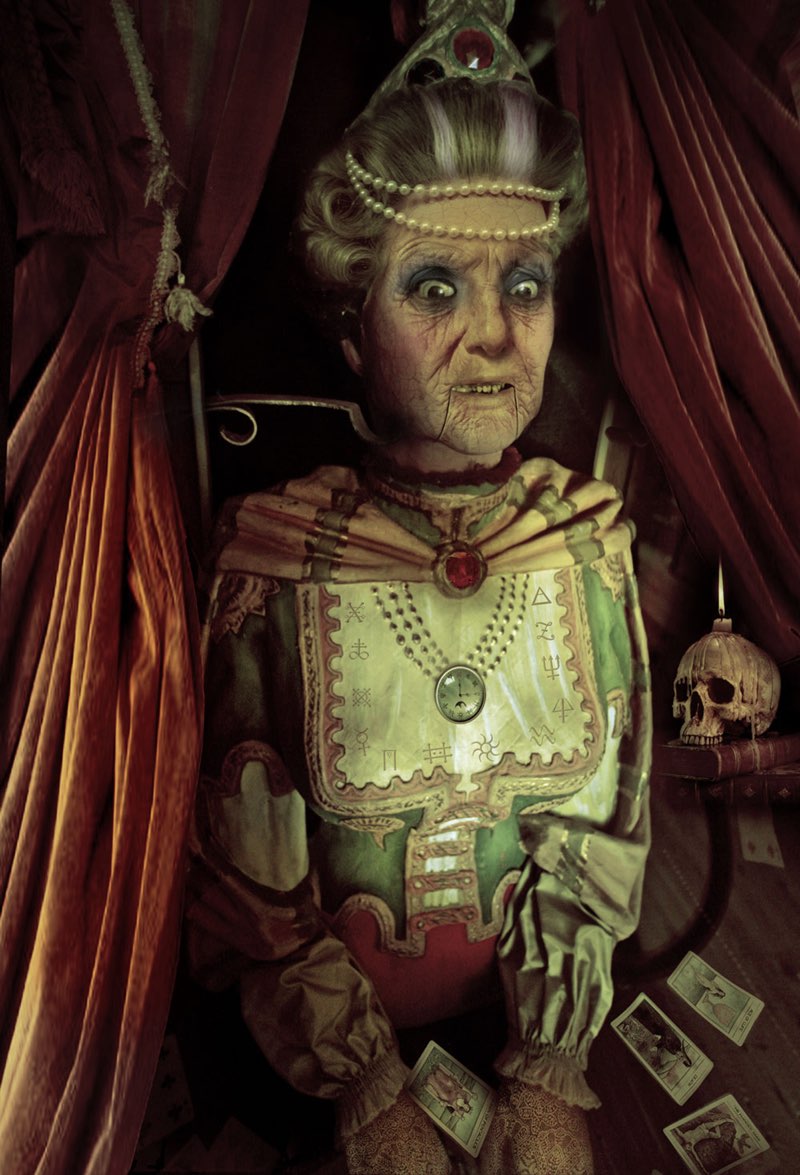
“One of the Watchmaker’s early experiments,” said César Magnusson. “He was desperate.”
Owen didn’t understand. “Desperate? How could the Watchmaker be desperate?”
But Magnusson merely stroked his extravagant mustache, pulling down the strands as if to cover a troubled frown. “Part of carnival life, young Owenhardy, is that we live in the present. Our timepieces always say now. Your past is not our concern, and you should not be concerned with ours. . . .”
So Owen remained curious, yet cautious. The old woman continued to live her sedentary life, to think her thoughts, and to dispense wisdom. Now that she had been disembodied, her brain was more attuned to cosmic vibrations and the thrumming threads of fate. She saw things that others didn’t.
On some quiet evenings Owen would wind the key on the side of the booth and keep the old gypsy woman company. While the anchors held her neck in place, the old woman conversed with him in a hollow, papery voice.
“You’re so old, madam,” Owen said. “Do you remember the world before the Stability?”
“Yes, I remember it.” Her wrinkled lips formed a smile, and her mechanical arms twitched and fidgeted. She turned her face as much as she could, given the constraints of her clockwork body.
“Was it ever so horrible?” Owen asked. “Savage and frightening? I read a book about it.” He shivered to think of the murder, starvation, and lawlessness.
Oddly, the gypsy woman smiled at his question. “I was young then, and the world seemed bright. So many things to see, places to explore, and friends . . . I had so many friends.”
Owen hunkered down. “But wasn’t it a nightmare, disorganized and dangerous? Barbaric.”
The clockwork woman made an odd, disrespectful sound. “It was a little of both—tedious at times, unpredictable at times. Normal life. The Watchmaker drew a tight box around society, but people are people.” A rattling sound came from her throat as the slowly turning key on the side of the booth wound down. “I wish that I could live it all again.”
The carnies gave Owen a seventeenth birthday celebration that was stranger, and more wonderful, than he could possibly have had in Barrel Arbor. If he’d been back home, he would have given his betrothal to Lavinia, with pre-scripted words, according to plan. He felt a pang to think of his true love, but then he paused, surprised to realize that he could barely remember what Lavinia looked like.
The carny cooks had baked a cake for him and presented it on the long plank table. In his booming voice, César Magnusson declared that “young Owenhardy” was henceforth to be referred to, with great respect, as simply “Owenhardy.”
To celebrate, Tomio created dozens of his small flaming sprites, which he set loose to dance and twirl in the air. The clowns Leke, Deke, and Peke performed pratfalls that made him laugh.
Deke snatched Tomio’s sword, puffed up his chest, and swaggered, slashing with the blade, pretending to trip and finishing with a brilliant somersault that landed him on his tiptoes. Then Deke demonstrated his own alchemical prowess. Miming a retching convulsion, he burped up a cloud of colored smoke.
Leke stuffed rags in his shirt sleeves and padded his shoulders to the point of absurdity, then strutted around like Golson, making a great show of lifting pieces of cake as if they were tremendous weights.
Peke appeared with a long dark wig, flouncing and swaying his hips and walking an imaginary line on the ground, obviously pretending to be Francesca. And then Deke snatched Owen’s porkpie hat and stared at the faux Francesca, eyes round, mouth gaping like a mooncalf. Deke pretended to swoon, falling on his back, and “Francesca” simply walked over the top of him. All the carnies laughed along with Owen (though he was the only one who blushed).
Everyone sang to him, out of tune but with great heart. Louisa even shared a small jug of hard cider she had procured in one of the recent towns. She poured him a mug to celebrate, and Owen’s voice caught in his throat. “This is the next best thing to the Tick Tock Tavern!” he said, and then realized it was untrue. This was even better.
Best of all, after he had eaten a second piece of cake and felt the warm satisfaction of a full belly and a warm heart, Francesca wiped a stray bit of frosting from his mouth and licked it off her finger. Then she leaned forward and kissed him full on the lips to whistles and catcalls from the other carnies.
Though he might have been homesick on his birthday, Owen gazed at Francesca and decided to stay with the carnival for a while longer.