Chapter 2
Campaign Promises
“Under democracy one party always devotes its chief energies to trying to prove that the other party is unfit to rule—and both commonly succeed, and are right.”
—H.L. Mencken, 1956
The president campaigns, sometimes for years, to be elected to the position. Because of the electoral college, this is not as straightforward as it sounds. It can be a lot of fun to watch if you have the right attitude.
Real Washington Outsiders
In this age, when it seems to be a political asset to not be an experienced Washington figure, William Henry Harrison, the ninth president, likely holds the record for the biggest jump in Civil Service position. A successful and popular general, Harrison chose after the War of 1812 to retire to his farm near Cincinnati. While he had previously served as governor of the Northwest Territory (those states that we now call the upper Midwest) he chose for a while to have a less stressful life. After retiring, the only office he held was that of clerk of the courts. But in 1840 the Whig Party was looking for a military hero to run for president. Harrison won in what became known as the Log Cabin and Hard Cider campaign. He went directly from local court clerk to president of the United States.
Grover Cleveland spent almost all of his life in Erie County, New York. His first elected office was sheriff in Buffalo, New York. It wasn’t until three years before being elected that the twenty-second and twenty-fourth president traveled substantially outside the county. His first trip to Washington, DC was for his own inaugural.
Role Model
Andrew Jackson had real problems with the way that the nation’s finances were handled. He disliked the federal banks and their monopoly on issuing money. He also was just plain old-fashioned about money. He was the first president to accomplish something that none of us has seen in our lifetimes: Jackson paid off the entire national debt and turned a technically solvent nation over to his chosen successor, Martin Van Buren.
California Dreaming
No president visited California until Rutherford B. Hayes in 1880. It didn’t have as many electoral votes in those days. But the entire West Coast was growing quickly in both population and economic importance. The journey from Washington, DC to California took several days on the transcontinental railroad and Hayes’s presence in the far west was a major novelty. He drew large crowds and often gave impromptu speeches.
Chads Redux
Close elections are not the sole property of George W. Bush and Al Gore. In 1880, James Garfield defeated Winfield Hancock by the narrow margin of only 9,464 votes nationally to become the twentieth president. Al Gore actually got half a million more votes than George W. Bush in 2000, fifty times more than the difference between Garfield and Hancock. Then there is what may be the most infamous election ever, that of 1876. That year, those in power engineered what would today be considered a coup, when three very Democratic voting states were excluded from the Electoral College. This allowed Republican Hayes to be elected by a single electoral vote. And you thought Florida seemed unfair.
Clinton Redux
When he had barely started his campaign, Grover Cleveland publicly admitted that he had once had an affair with a lady from New York named Maria Halpin. It was also public knowledge that her son was likely his. It had very little effect on the campaign, this being before the days of TV and blogs. Unlike the Monica Lewinsky affair, where President Clinton hedged, stalled, and lied, Cleveland came clean early and that made all the difference in keeping the faith of the American people.
And Without A Teleprompter
The news crews that follow candidates and elected officials often hear the same speech so often they can recite it better than the candidate. They sit there just waiting for some new sentence or paragraph in the canned talk that will give them something to write or talk about. This may be one reason they always look so bored when the audience is shown. There was one time when this definitely was not the case. One of our brightest and most scholarly presidents was Benjamin Harrison. Even his enemies acknowledged that he was a brilliant orator. Perhaps his most noteworthy achievement in this regard occurred on a thirty-day tour of the Pacific Coast states. He gave about 140 speeches, and each one was original. Some were written in advance, by Harrison in most cases; others were given on just a few minutes’ notice when a crowd had gathered spontaneously. Today’s news staff can only look back with envy.
Losers
The men who became president did not all have a smooth rise to power. A surprising number of them lost one or even several elections before attaining the nation’s highest office.
Lincoln: Lost race to become U.S. senator from Illinois
Jackson: Lost his first presidential race
Nixon: Lost the presidency to Kennedy and his race for governor of California two years later
Benjamin Harrison: Was defeated running for both governor and senator of Indiana
Polk: Twice defeated when running for governor of Tennessee
McKinley: After fourteen years, lost the election to serve his eighth term in Congress
Harding: Defeated running for governor of Ohio
Fillmore: Lost a run at governor of New York
Coolidge: Couldn’t get elected to the school board in Northampton, Massachusetts
Cleveland: Lost a bid to become the prosecuting attorney for Buffalo, New York
Teddy Roosevelt: Was beaten when running for mayor of New York City
Franklin Roosevelt: Ran for vice president and lost
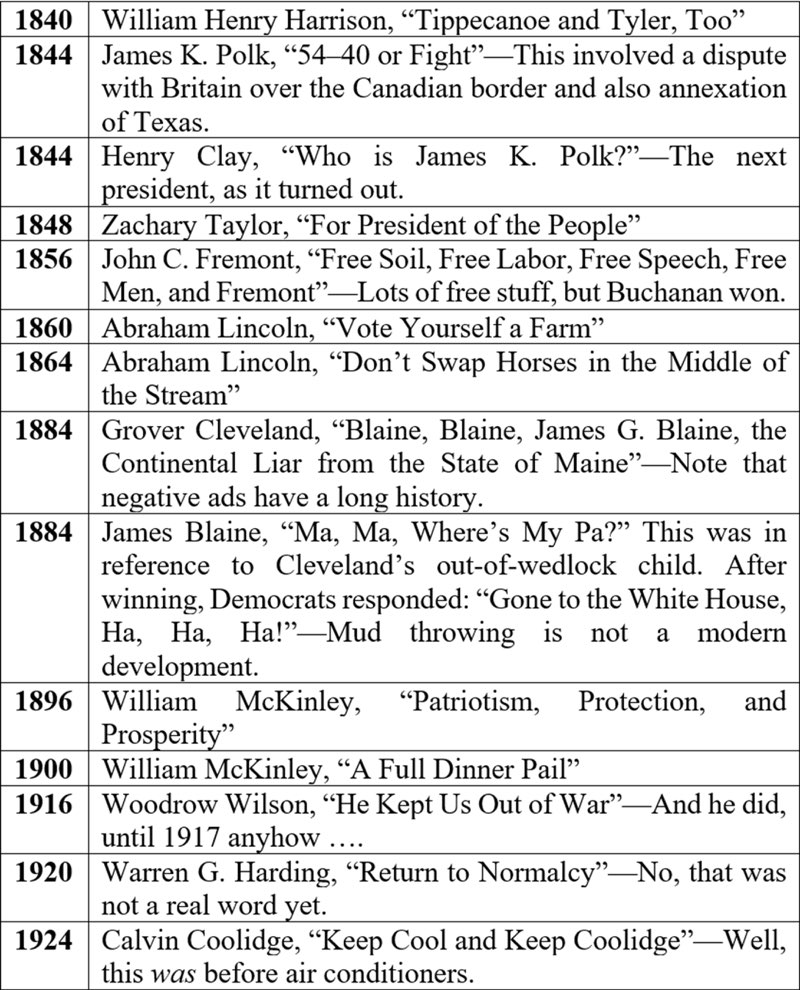
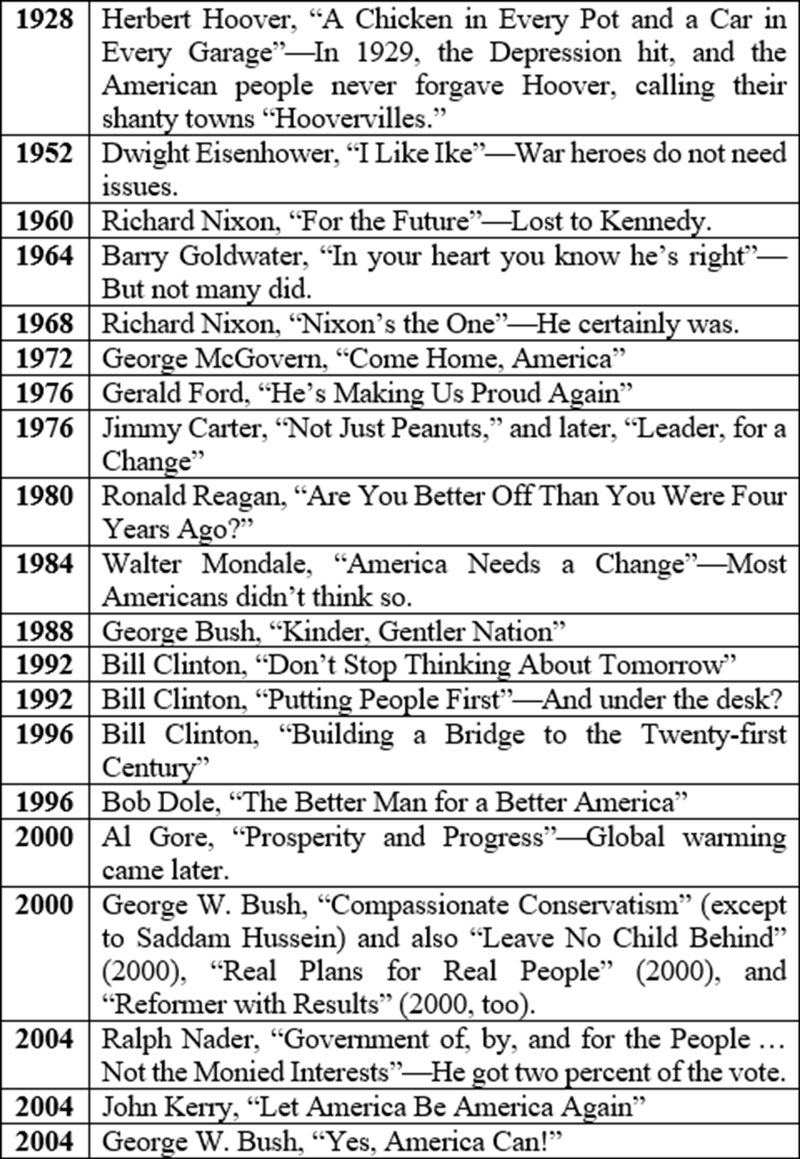
Selected Campaign Slogans
Slogans became popular when the nation expanded and the ability of the people to know the candidates diminished. At first they referred to specific issues or promises. Lately they seem to have become more generalized propaganda.
All Fifty States
Early in his campaign in 1960, Richard Nixon vowed to be the president of all the people and to campaign in all fifty states. This included the relatively new and distant state of Alaska, with a paltry three electoral votes. Considering what came later, and maybe even a bit because of this, with just a few days before the voting and the race with Kennedy too close to call, Nixon spent a full day on a side trip to campaign in Alaska, the only state he had not yet been in. Kennedy spent that same day in the major states and later won. It wasn’t good politics, but Nixon kept his word.
Log Cabin Syrups
It was a common claim by politicians in the nineteenth century that they had been born in a log cabin. This helped to portray them as just being one of the people. In six cases, presidents actually were born in log cabins. These six are Jackson, Taylor, Fillmore, Buchanan, Lincoln, and Garfield. One of the most adamant of the claimants was William Henry Harrison, who was actually born in a rather large Southern mansion on the James River. But he got away with it until the biographers began checking.
Campaign Manager
The campaign manager who got Andrew Jackson elected was Martin Van Buren. There was a much smaller gulf in those days between the campaign and the politicians. Van Buren convinced Andrew Jackson to do one very unusual thing that probably got him elected president. This was an era when politics were very rough-and-tumble and two issues split the country in different ways. The first issue was slavery. This caused a split between the Northern and Southern states. The other issue was money: who could print it and what banks could issue it. This was an important pocketbook concern for many voters, since those settling new land or starting a business needed “easy money,” while the established money interests wanted to protect the value of their assets. So the country was split between social classes, and also frontier versus older states, on money. The result was a series of vicious congressional sessions. Tempers were high enough to result in physical violence. And don’t forget it was the time when duels still took place, though illegal. What Van Buren did was to get Andrew Jackson to resign from the U.S. Senate. By doing this, he was able to return to his estate in Tennessee and avoid being part of the partisan bickering. This meant his reputation as a victorious general and statesman remained intact, since he was less of a target than those voting in Congress. By the time it was apparent that Jackson was going to run for president, and he had become a target of the really dirty politics of that day, his position with the voters was secure. By avoiding the fights in Washington, he managed to appear to stand above them. While the election was hard fought and his enemies diligent in their efforts after he had won, Andrew Jackson was elected to two terms.
The genius campaign manager was even able to convince several dozen congressmen to pledge their personal fortunes in order to set up printing presses used to further Old Hickory’s campaign. That’s something we are not likely to see the equivalent of today. Jackson rewarded Van Buren, whom he called a political genius, by naming him as the man he wanted to succeed him and in 1836, after Jackson retired, Van Buren won. So by leaving his job as senator from Tennessee, Andrew Jackson was able to become president.
Financial Flip-flop
While being shown to be a “flip-flopper” condemns today’s politicians, there are a number of presidential flip-flops that served the country well. One of these involved the biggest sale of land in history. Knowing that Napoleon was short on money, Thomas Jefferson sent a delegation headed by John Adams and Robert Livingston to Paris with an offer. The offer was to rent or purchase the right for American traders to move freely through New Orleans, which was becoming vital to businesses in what are now the Midwestern states. To the delegates’ amazement, Napoleon offered them the entire territory at a large but bargain price. Now, this was not all generosity. The French navy had been virtually driven from the seas and there was a good chance he would lose the territory, which had just been recovered from Spain, to the British anyhow. Better to sell the lands to the Americans who could defend it than to simply lose it to the Redcoats.
But there was a problem. One of the most adamantly-stated portions of Thomas Jefferson’s campaign was that the United States was not going to borrow any money. (Heaven knows how the Founding Father would react to today’s deficit spending.) But the new nation did not have enough money to complete the purchase. Deciding that obtaining nearly a third of the present U.S. area was more important, Jefferson flip-flopped and quickly urged the Senate to buy Louisiana from Napoleon. Except for certain low-lying neighborhoods in New Orleans, it still looks like one of the wisest flip-flops ever performed.
From the Birds
Millard Fillmore ran for vice president and made few promises. This is probably a good thing, because when he took office upon Taylor’s death, his list of accomplishments was short. Almost every action he took or desired was held hostage to the slave/free state debate. His first accomplishment was bringing California into the Union. This was marred by the Fugitive Slave Act, which greatly expanded federal involvement in returning slaves who had escaped to free states. His second accomplishment was to send Admiral Perry to open up trade with Japan. This worked, though some say the eventual result of how this was handled was Pearl Harbor. Finally, Millard Fillmore’s big diplomatic accomplishment was to negotiate a treaty with Peru that gave the United States access to the Guano Islands. These islands proved an invaluable source of nitrogen-rich materials. Nitrogen is used to manufacture explosives and ammunition. The actual source of this nitrogen, and Fillmore’s diplomatic accomplishment, is yards-deep piles of bird droppings that have accumulated over thousands of years on the Pacific islands.
Freedom to Flip-flop
When Abraham Lincoln campaigned in 1860, he promised many times that the Federal government under his leadership would not interfere with the right to hold slaves. The reason was to attract Southern voters. The ploy didn’t work. Its failure was called the American Civil War. On January 1,1863, he flip-flopped and signed the Emancipation Proclamation. This had no immediate effect on slavery in the South but helped to turn the war into a Crusade to Free the Slaves, making liberals and many European governments happy.
FDR’s Big Flop
Franklin Delano Roosevelt campaigned on the idea that one of the main reasons for the Great Depression was the deficit spending of the Federal government. Rather soon after taking office, this was forgotten and he began borrowing and spending on a massive level in an effort, only partially effective, to end the financial crisis. (World War II spending finished the recovery.) Had he kept his promise, the United States might well have not been in a position to be victorious in World War II.
Profile in Courage
While Andrew Johnson, who became president upon Lincoln’s assassination, was a bigot, made a less than competent president, and managed to antagonize nearly everyone, he also demonstrated great personal courage. When the Southern states, including his own Tennessee, were deciding to secede, he was just about the only major Southern politician to publicly oppose the popular action. Because of this, he was often at risk of attack or worse. While traveling by train through Virginia, which lies between Tennessee and Washington, DC, Johnson once had to force a mob of irate secessionists off the train with a loaded pistol. This didn’t work twice, and a more determined mob of Virginians did manage to drag Andrew Johnson off a train and beat him badly. There appears also to have been a serious debate as to whether or not to hang him as a traitor as well. The most likely reason that this did not happen was that the mob did not want to take the fun away from the secessionists in Tennessee, who had first call on hanging their former governor. After these incidents, Johnson felt it was necessary to keep a gun near him while delivering his anti-secession speeches.
Abraham Lincoln appreciated his brave pro-Union stand and made Johnson his vice president in hopes of gaining credibility among the Southern, or at least border, states.
329
There was a major scandal that outraged the nation while Grant was president. Okay, actually there were several scandals while Grant was president, but this one was a doozy and included many congressmen and senators among the guilty. The scandal was named after the company involved, Credit Mobilier, and involved government contracts, stock manipulation, kickbacks, and insider trading on a grand scale. When the dust settled, it appeared that, out of the tens of millions involved, James Garfield had received stock dividends from Credit Mobilier to the total of a paltry $329. There was really nothing to show Garfield was actually involved, but that did not stop his opponents in the 1880 election from scrawling the number 329 on every wall and barn roof they could find. They were hoping to label the twentieth president as corrupt. Though I have to suspect (perhaps it is my Chicago upbringing) that there was also an element of disdain. People stole millions of dollars in the railroad scandals, and all Garfield got was a lousy $329.
Substitute
At this time there is great debate over how honorably George W. Bush or John Kerry served in the military. It appears that such service a hundred years ago was less important to being elected. During the Civil War, the Union Army was concerned with filling its ranks and not at all with who filled them. With a war on, being a soldier was not only inconvenient but dangerous. Civil War casualties totaled in the hundreds of thousands. A common practice during the American Civil War was the purchase of a substitute. If someone who had money was drafted, it was perfectly legal to pay another person to serve instead of you. Think of it as the ultimate student deferment. This is what Grover Cleveland did. When he got the notice he was going to have to report to the army, he had very little desire to go. This was likely less a question of courage or patriotism than a reflection of his attitude that all exercise was at best unfortunate and to be avoided. Certainly, being part of an army that marched hundreds of miles carrying heavy packs was out. The twenty-second (and twenty-fourth) president hired a Polish immigrant to serve in his place. This cost him the sum of $150, less than $5,000 in today’s money.
Front-porch Campaign
It took eight ballots for the Republicans to nominate Benjamin Harrison at their 1888 convention. He then sat for office rather than ran for it. Harrison conducted what became known as his “front-porch campaign” by spending most of the election in Indiana on his front porch, where he gave speeches and met with those who came to see him. He was the grandson of President William Henry Harrison of the battle of Tippecanoe fame.
Bona Fides
Because of her ill health, Ida McKinley rarely campaigned or appeared with her husband. This was fairly well-known around Washington, but if you think things are vicious today, around the turn of the century everything was fair game with any lie that could be passed. Those opposing McKinley in 1896 began to spread the rumor first that Ida was some sort of freak, then that she was reported to be a spy, and eventually that she was hiding bruises from spousal abuse. None of the stories were true and eventually the Republican Party published her biography to show the voters what Ida was really like. It was the first time that information on a future First Lady became part of the official campaign.
Wilson’s Flip
The campaign motto that helped reelect Woodrow Wilson in 1916 was “He Kept Us Out of War.” Two years later there were almost a million American doughboys in the trenches of France. But since we won that war, all was forgiven. Pity he lost the peace afterward by conceding the vindictive terms on the Treaty of Versailles in exchange for support for the stillborn League of Nations.
The Loser Winner
You may think the poll numbers reached an all-time low in Bill Clinton’s or George W’s second term, but those are percentages in the mid-thirties. In the 1912 election the incumbent president, William Howard Taft, got a pitiful twenty-three percent of the vote, losing to both Woodrow Wilson and Theodore Roosevelt.
Silent Cal
Calvin Coolidge seemed to value every word and hold them to himself like a miser. His nickname of “Silent Cal” was well earned. Normally when a candidate holds a press conference they say a lot, even if they do not have a lot to say. This is not how it was with Calvin Coolidge. A few lines from a press conference he held in 1924 shows this better than any of my words.
Reporter: Have you any statement from the campaign?
Silent Cal: No.
Reporter: Can you tell us something about the world situation?
Silent Cal: No.
Reporter: Any information about Prohibition?
Silent Cal: No.
To add insult to injury, as the reporters left, likely wondering just what they could write to justify their pay for that day, the candidate also reminded them not to quote him. It seems likely they didn’t.
One quote about Calvin Coolidge comes from the famous author Dorothy Parker, a regular among the famous wits of the Algonquin Roundtable: when it was announced that the somniferous and silent former president had died, her comment was “How could they tell?”
As Promised
Although Calvin Coolidge fulfilled the promise he made when taking office as president to rid the government of the graft and corruption that had marked the Harding presidency, there was a lot he didn’t tell John Q. Public about his own people that came back and bit him later. It seems Silent Cal was a fan of big money and big business. He introduced a massive tax cut for the very rich, but vetoed any legislation meant to help the poorer segments of the population. The result was that wealth became concentrated more than ever and the economy began the slide into what was later known as the Great Depression. Much more than Hoover, who was mostly guilty of inaction, this economic disaster can be attributed to Calvin Coolidge’s policies. This is a time when government was not supposed to get involved in the business of America, but the thirtieth president raised that policy to an indolent, but eventually disastrous, extreme.
First Time Lucky
Herbert Hoover had not only never run for national office when he became the Republican candidate for the presidency in 1928, but he had never run for any office in his life, except class treasurer when attending Stanford University. He defeated the Democrat Al Smith decisively in what turned out to be the only time Hoover ever campaigned for any office.
Academically Average
Dwight D. Eisenhower, who commanded the Allied armies in Europe during World War II and spent two terms as president, just barely graduated in the top half of his class at West Point. He finished eighty-first out of 164.
Never, Well, Hardly Ever
When both parties first approached General Eisenhower to be their candidate for president, he was less than receptive. His exact words were, “I cannot conceive of any circumstance that could drag out of me permission to consider me for any political post from dogcatcher to grand high king of the universe.” The World War II war hero later changed his mind and became the thirty-fourth president.
Second Time Lucky
John Kennedy was only the second Catholic to ever run for the presidency. The first Catholic candidate was Al Smith, who lost badly in 1928. JFK was also the first man to hold the office who was born in the twentieth century.
Own Fault
There is no question that JFK acted heroically after his boat, PT109, was struck and sunk by a Japanese destroyer. One of the reasons he had to do what he did to save an injured crew member was because, against regulations, there was no lifeboat on PT109. Like many of the courageous commanders of the Patrol Boat Torpedo, JFK modified his boat to improve its combat ability. In this case, he replaced the PT boat’s only lifeboat with a .50-caliber machine gun. Such changes on the crew’s initiative were both common and illegal during World War II. Many smaller ships and planes, including freighters and even bombers, had guns added by those who manned them. As commander of the modified PT boat, JFK could have been found by the navy to be partially at fault for the very problem of his men being in the water, in addition to being a hero for how he handled the disaster. Though, as the son of the highly-connected Joseph P. Kennedy, it was most unlikely the Navy Board would find against him. And he did save the crew, personally carrying one man to safety, so if at fault, he was also a true hero.
A Deal He Could Not Refuse
At least some of the stories about JFK and the mob have substance in fact. Before the 1960 election, Joseph P. Kennedy, JFK’s father, not only met with the notoriously corrupt Judge Tuohy, but attending the same meeting making sure Jack Kennedy was elected was Sam Giancana, the head of the Mafia in Chicago. At this time many of the unions were controlled by the mob (some say many still are) and Giancana promised and delivered the union vote and thousands of union member workers for the JFK campaign. Of course there is no record of what the rest of the deal made with the mob was. After the election, the attorney general chose not to investigate the rumors. The new attorney general was Bobby Kennedy.
Mobbed Up
Jack Kennedy was a womanizer at a level almost bordering on addiction. This caused him to have another up close and personal connection to mob boss Sam Giancana. It seems that both men were intimately involved with the same very attractive woman, divorcee Judith Exner. Now it is likely one of the few men who could play around with the Chicago don’s girl and get away with it would be the president of the United States. Then again, maybe JFK wasn’t so sure of that himself. When informed by the FBI of her other relationship, he ended the affair.
Tricky Dick
Richard Nixon didn’t begin playing dirty with Watergate. He won his first two elections as representative, and then senator, from California by wrongly accusing his opponents of being communists. He described one as “pink down to her panties.” Okay, he was a sexist, too. These tactics worked because he was good at making allies that could help spread any message he chose, some being in the mob. His ability to smear others is what, early in his political career, earned him the nickname “Tricky Dick.”
At Whose Expense?
Most people forget that what raised Richard Nixon above the crowd and earned him the VP spot with Dwight Eisenhower was his actions on the now discredited and downright embarrassing House Un-American Activities Committee, working closely with, and just as rabidly as, the now discredited Senator Joe McCarthy. More than anything else, it was Nixon’s determined and dogged pursuit of Alger Hiss, a government official who had held several important positions under FDR and was accused of being a Communist, that got him the job.
Bush or Dole in 2008?
Since 1976, there has not been a Republican presidential ticket that did not have on it someone named Bush or Dole. Here is how that breaks down:
1976 Dole for vice president
1980 George H. W. Bush for vice president
1984 George H. W. Bush for vice president
1988 George H. W. Bush for vice president
1992 George H. W. Bush for president
1996 Dole for president
2000 George W. Bush for president
2004 George W. Bush for president
Unknown
When the mother of then dark horse and nationally unknown candidate Jimmy Carter heard he was running for president, her first response was to ask, “President of what?”
A What?
For most of his life Ronald Reagan was not only a Democrat but a serious New Deal-loving Roosevelt Democrat at that. In 1938, the future president played with the idea of joining the American Communist Party and may even have been turned down for not being one of the party’s true believers. When head of the Screen Actors Guild from 1947 to 1954, he supported Democratic candidates. But by the 1960s he had become a Republican. Reagan’s speech at the 1964 Republican convention in support of nominee Barry Goldwater was so well received that it instantly elevated him to the attention of that party’s leaders. (You have to wonder why they were surprised that a man who had acted in fifty-one movies, made an ape look good in one of them, and been “the dying Gipper” in another could deliver a speech well.) Ronald Reagan was soon elected governor of California and was considered a likely alternative to the incumbent Gerald Ford in 1976. Jimmy Carter beat Ford, mostly due to his unpopular pardon of Richard Nixon. Reagan was the nominee in 1980 and got revenge, trouncing Carter. You have to wonder what the young Reagan’s hero, FDR, would have thought about it.
Upstaged
After the Nixon-Kennedy debates, where Kennedy’s appearance and poise won over the TV audience and had a decisive effect on the election, the events have been considered “make or break” for any candidate. They are preceded by rehearsals and even posture and speech lessons. An overemphatic sigh on one debate that was caught on camera may well have lost Al Gore the election. Bush was speaking and the camera panned to Gore who theatrically and audibly sighed. The air of superiority this gave Gore was thought to have cost him support in many states where he lost by only a few thousand votes. Then again, the debates didn’t intimidate every candidate. When Ronald Reagan was asked if he was nervous about debating the current president, Jimmy Carter, he answered, “No, not at all. I’ve been on the same stage with John Wayne.”