INTRODUCTION
by Bill Fawcett
You are in command. With the recorded blare of trumpets accented by a non-com's hurriedly barked order, it's back to battle for the Slammers. Mounting their tanks and skimmers are your men, highly trained mercenaries, whose lives depend upon the decisions you are about to make.
Slammers Down! provides more than just another chance to read an exciting military adventure featuring Hammer's Slammers. You could simply "read" this book, tracing a route through the sections, but these books are also a "game" which lets you make the command decisions.
This book is divided into sections rather than chapters. In each section of this game/book a military situation is described. Your choices actually write the book, both the story and the ending being determined by the combat decisions you make.
A careful effort has been made to make these adventures as "real" as possible. You are given the same information as you would receive in a real combat situation. At the end of each section is a number of choices for what to order next. The consequences of the action you pick are described in the following section. When you make the right decisions, you are closer to completing your mission successfully. When you make a bad decision, tanks burn and men die . . . men who are not going to be available for the next battle.
FIGHTING BATTLES
This book includes a simple game system, which simulates combat and other military challenges. Playing the game adds an extra dimension of enjoyment by making you a participant in the adventure. You will need two six-sided dice, a pencil and a sheet of paper to "play" along with this adventure.
COMBAT VALUES
In this book the force you command will consist of one force of tanks and one force of infantry skimmers. Each force is assigned five values. These values provide the means of comparing the capabilities of the many different military units encountered in this book. These five values are:
Manpower
This value is the number of separate fighting parts of your force. Each unit of Manpower represents one man, one tank, or whatever is firing. Casualties are subtracted from Manpower.
Ordnance
The quality and power of the weapons used is reflected by their Ordnance Value. All members of a unit commanded will have the same Ordnance Value. In some cases you may command two or more units, each with a different Ordnance Value.
Attack Strength
This value indicates the ability of the unit to attack an opponent. It is determined by multiplying Manpower by Ordnance (Manpower x Ordnance = Attack Strength). This value can be different for every battle. It will decrease as Manpower is lost and increase if reinforcements are received.
Melee Strength
This is the hand-to-hand combat value of each member of the unit. In the case of a squad of mercenaries, it represents the martial-arts skill and training of each man. In crewed units such as tanks or spaceships, it represents the fighting ability of the members of the crew and could be used in an assault on a spaceport or to defend against boarders. Melee Value replaces Ordnance Value when determining the Attack Strength of a unit in hand-to-hand combat.
Stealth
This value measures how well the members of your unit can avoid detection. It represents the individual skill of each soldier or the Electronic Counter Measures (ECM) of each spaceship. The Stealth Value for your unit will be the same for each member of the unit. You would employ stealth to avoid detection by the enemy.
Morale
This value reflects the fighting spirit of the troops you command. Success in battle may raise this value. Unpopular decisions or severe losses can lower it. If you order your unit to attempt something unusually dangerous, the outcome may be affected by their morale level.
THE COMBAT PROCEDURE
When your unit finds itself in a combat situation, use the following procedure to determine victory or defeat.
1. Compute the Attack Strength of your unit and the opposition. (Manpower x Ordnance or Melee Value = Attack Strength).
2. Turn to the charts at the end of this section which are given in the description of the battle.
3. Roll two six-sided dice and total the result.
4. Find the Attack Strength of the unit at the top of the chart and the total of the dice rolled on the left-hand column of the chart. The number found where the column and row intersect is the number of casualties inflicted by the unit you were rolling for onto their opponent.
5. Repeat for each side, alternating attacks.
The unit you command always fires first unless otherwise stated.
When you are told there is a combat situation, you will be given all the information needed for both your command and the opponent.
If two types of vehicles (tanks and skimmers) are fighting as one force, compute the attack value for each and total the results. Losses should alternate between each type, with the skimmer mounted infantry taking the first loss.
Here is an example of a complete combat:
Hammer's Slammers have come under fire from a force defending a ridge which crosses their line of advance. Alois Hammer has ordered your company of tanks to attack. Your tanks have an Ordnance Value of 8 and you have a Manpower Value of 8 tanks.
Slammers fire using Chart B.
Locals fire using chart D with a Combat Strength of 3 and Manpower of 12 (This gives them an Attack Strength of "36").
To begin, you attack first and roll two 4s for a total of 8. The current Attack Strength of your Slammers is 64 (8 x 8).
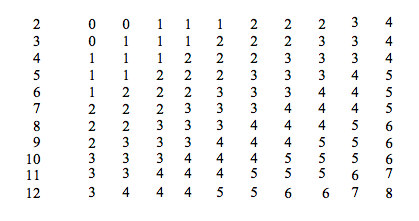
CHART B
Attack Strength
1-10 -20 -30 -40 -50 -60 -70 -80 -90 -100 101+
Dice
Roll
Read down to 70 Attack Strength column until you get to the line for a dice roll of 8. The result is 4 casualties inflicted on your opponents by your company.
Subtract these casualties from the opposing force before determining their Attack Strength. (Combat is not simultaneous.) After subtracting the 4 casualties your company just inflicted on them, the enemy has a remaining Manpower Value of 8 (12 -4 = 8). This gives them a remaining Attack Value of 24 (8 x 3 = 24).
Roll two six-sided dice for the opposing force's attack and determine the casualties they cause your Slammers company. Subtract these casualties from you Manpower total on the Record Sheet. In this case they caused one casualty, giving the Slammers a Manpower of 7 for the next round of combat.
This ends one "round" of combat. Repeat the process for each round. Each time a unit receives a casualty, it will have a lower value for Attack Strength. There will be that many fewer men, tanks, spaceships, or whatever firing.
Continue alternating fire rolls, recalculating the Attack Strength each time to account for casualties, until one side or the other has lost all of its Manpower, or special conditions (given in the text) apply. When this occurs, the battle is over.
Losses are permanent and losses from your unit should be subtracted from their total Manpower on the record sheet.
SNEAKING, HIDING AND OTHER RECKLESS ACTS
To determine if a unit is successful in any attempt relating to stealth or morale, roll two six-sided dice. If the total rolled is greater than the value listed for the unit, the attempt fails. If the total of the two dice is the same as or less than the current value, the attempt succeeds or the action goes undetected. For example:
Rico decides his squad of Mobile Infantry (MI) will try to penetrate the Bug hole unseen. MI have a stealth value of 8. A roll of 8 or less on two six-sided dice is needed to succeed. The dice are rolled and the result is a 4 and a 2 for a total of
6. They are able to avoid detection by the Bug guards.
If all of this is clear, then you are ready to turn to Section 1, meet with Alois Hammer, and take command.
COMBAT GROUP FOXTROT
(see also Appendix A)
Hovertanks (8 to begin)
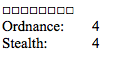
Skimmer Infantry Squads
(12 to begin)
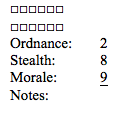
Unless otherwise specified, both units will attack. Total both of their attack values together before rolling. When both types of units are involved alternate casualties, infantry is first.