CHAPTER II
A CHALLENGE TO SCIENCE
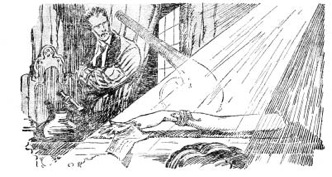
IT was a human arm and hand lying on a violet silk cushion. The blood appeared to be congealed around the humeral section. Some crimson splashes on a piece of white linen, which had been thrown down beside it, attested to a recent operation.
It was the arm and hand of a young woman.
A bracelet of chased gold, in the form of a serpent, was clasped around the delicate wrist. On the ring finger of this left hand a sapphire ring flashed brilliantly. And the exquisitely slim fingers still retained their hold on a pearl gray glove which, evidently, had been worn several times.
The flesh was so lifelike in tint, so soft and satiny, that the sight of it was poignantly cruel.
What could have necessitated this drastic, desperate operation? What unknown, terrible harm could have brought about this frightful amputation? And, above all, what had caused this arm to retain its healthy vitality? The blood still seemed to flow in this sweet and gracious member.
But a chilling, sinister thought would have leaped in the mind of a stranger at the sight of it.
The large country house which stood alone like a gloomy castle among the trees was an isolated abode, and Professor X, as all the world knows, a daring experimenter. It was only to his closest friends that he showed any signs of affection.
His discoveries as an engineer; his inventions of various kinds, the least strange of which are alone known to the general public; conveyed the impression of an enigmatic positivism.
He had compounded an anesthetic so powerful in its effect that, in speaking of it, his flatterers said: “If only one had the time to absorb a few drops of it, one could face the most subtle tortures without being aware of it.” And, now, was he trying a new experiment, before which a doctor might well flinch Was he striving to fathom the existence of another? Or was he trying to solve his own?
What scientist, worthy of the title, would not, if only for a moment, dwell without remorse, and even without shame, on thoughts of this order, when it was a question of a great discovery?
The press, all over the world, had given much space to describing the nature of some of his experiments. Many of the tests which he had desired to make had been forbidden by the government of his country.
A layman might feel, legitimately, a suspicion that the great scientist had been trying some experiment which had ended fatally, some venture of which this beautiful, radiant arm, rudely severed from its place, was the souvenir.
Meanwhile, as he stood beside the ebony table, Professor X looked meditatively at the telegram which had fallen between two fingers on the hand. He touched the hand, and, then, he started, as though a sudden idea had come to him.
“Ah,” he murmured, “suppose it should happen, suppose— suppose that Lord Ewald—suppose it is he who will be the one to awaken Hadaly.”
The word “awaken” was uttered by the scientist in a rather odd, hesitating, manner. After a moment he shrugged his shoulders and smiled.
“Bah!” he muttered. “I must not let my thoughts race ahead in this fashion.”
He resumed his striding up and down the laboratory. He evidently preferred to be in the dark, for he switched off the lights.
Suddenly the moon passed between the clouds, and sinisterly slipped a streak of light onto the black table.
The pale ray caressed the inanimate hand, lingered on the arm, and threw a gleam into the eyes of the gold snake and a flash on the ring.
Then all became dark again.
Professor X pondered, as he paced to and fro in the darkness, upon all the wonderful inventions he had given to the world.
He thought of all the great scientists of the past; those famous engineers who built the temple of Cheops, and all the other wonders which have been left to endure through the ages; of the architects who had left their imprint on colossal, marvelous ruins which were, even now, masterpieces unexcelled. Was it not strange that some of these deep minds had not conceived the things which he had perfected?
As his mind passed down through the cycles of history, he conjured up pictures of the marvelous men and women whose names have been inspiring to us. How beneficial it would be if we could have had preserved for us their actual photographs. What a loss that this art had been so long deferred!
What remarkable progress might have been made possible if we only had actual photographic records of the progressions of natural history. How quickly nature had effaced the traces of her first efforts. What precious visions had been lost!
And he felt a great feeling of thankfulness within him. A thankfulness that, because of his having existed, because of his inventions, mankind would henceforth reap great benefits.
And, more than that, if it were possible—if the great God, the Lord of Life, of whom so many painters and sculptors had tried to give us an image—if this Mighty, Most High would but permit a photograph of Himself to be taken, would but permit the sound of His- voice to be recorded, from that day on there would not be left an atheist on the face of the earth.
As it was his habit, the professor had been softly speaking his thoughts aloud as he paced to and fro in the laboratory. He now stopped and Iqoked absently through the openings of .the long French windows, staring at the rays of light which the moon cast across the lawn.
“So be it,” he murmured, resuming his soliloquy. “Let it be defiance for defiance. Since life will not deign to answer our questions, but treats all our inquiries with a profound and problematic silence, we will defy life-creation. I have already taken the prodigious step, and now have something to show.”
At this moment, the professor caught sight of a human shadow through the glass doors.
“Who is there?” he cried, his fingers closing over the butt of a small revolver in his pocket.
“It is I—Ewald,” replied a voice.
“My dear Lord Ewald. Welcome!”cried the professor, as he came forward to greet his guest.
Three unusually large lamps, with globes of blue glass, simultaneously burst into flame like huge torches of electricity, lighting up the laboratory.
The visitor was about twenty-seven years old, tall, manly, and extremely handsome. He was immaculately groomed, and his magnificent physique suggested his apprenticeship on the crews of Oxford or Cambridge.
His face; calm in repose, was sympathetic in expression, but the look in his eyes was grave and somewhat haughty.
“My dear friend,” said the inventor. “All that I now have I owe to you, for, without the help you once gave me, I could have accomplished nothing.”
“No, no, professor,” said Lord Ewald, smiling, “it is I who am indebted to you. Through you I was able to be useful to the rest “f humanity. The bit of money meant nothing to me.
“See how fortunate I consider myself in having met you! As soon as I put foot in your country I hasten to call to see you, for I want to renew the friendship that began with a chance meeting.”
Professor X now suddenly detected that there was something subtly wrong with his guest.
“I see you think that I am ill,” continued the younger man, with a slight understanding smile. “I am not suffering physically, I assure you. But I have an everlasting grief and, I suppose, that would make one look a bit off in the course of time.”
Lord Ewald glanced about the perfectly appointed laboratory, paying particular attention to the lighting.
“I must congratulate you on all that you have accomplished in such a short time,” he continued. “You are certainly the chosen one—a veritable genius. This marvelous lighting is your own invention, I presume?”
The professor nodded.
“It is like a brilliant afternoon in summer time,” said his lordship.
“Again thanks to you,” his host declared with a smile.
“It is all very wonderful; you are an electrical wizard.”
“Well,” said the professor modestly, “I have discovered a few little things—and also some important things that I want to tell you about. I was just thinking, before you arrived, that my inventions should have been known centuries ago.”
Lord Ewald listened politely to his host, but it was evident that his secret sorrow obsessed him. The professor’s keen eyes scanned the young man’s face searchingly. There was a moment’s silence.
“My dear Lord Ewald,” said the inventor, gravely, “permit me to assume the role of an old friend and interest myself in you. I can see there is something very wrong. Your trouble?”
The younger man tapped the cold ashes from his cigar, and looked at his host, but said nothing.
“You know that I am a physician also,” continued the professor, “and I am one of those who believe that there is a remedy for every illness.”
“Oh, the grief in question,” responded Lord Ewald, trying to speak lightly, “is a very commonplace subject—an unfortunate love affair. It has hit me hard. You see, now, that my secret is very ordinary. I shall always suffer, but, please, do not let us speak about it.”
“You unfortunate in a love affair!”cried the doctor, in astonishment. “You the victim! Why, that almost seems impossible. I—”
“Pardon me,” interrupted his young friend, “I have only a short time to spend with you and I do not wish to abuse your time. I think the conversation will be far more interesting if we talk of you and what you have accomplished.”
“Why, my time is all yours!” cried the inventor. “Those who admire and laud me to-day once ignored me and would have allowed me to die like a homeless dog—all but you.
“My affection for you is sincere, and it has rights which are just as sacred as yours, my dear young friend. Perhaps I may be able to cure you, or, at least—”
“No,” interrupted Lord Ewald, with a bitter smile, “unfortunately, you can do nothing—science cannot go as far as that.”
“One never knows,” declared the professor. “Science has astonished me. I am always working—always probing—always discovering. Who can tell?”
“I know that you could not understand the sentiment I have in this affair,” the young man demurred. “It would be strange— inconceivable to you.”
“So much the better,” exclaimed the professor. “It will be a challenge to my imagination.”