Chapter 1
Pay No Attention to
the Man Behind the Curtain
Greg McPartlin
—McPartlin Collection—
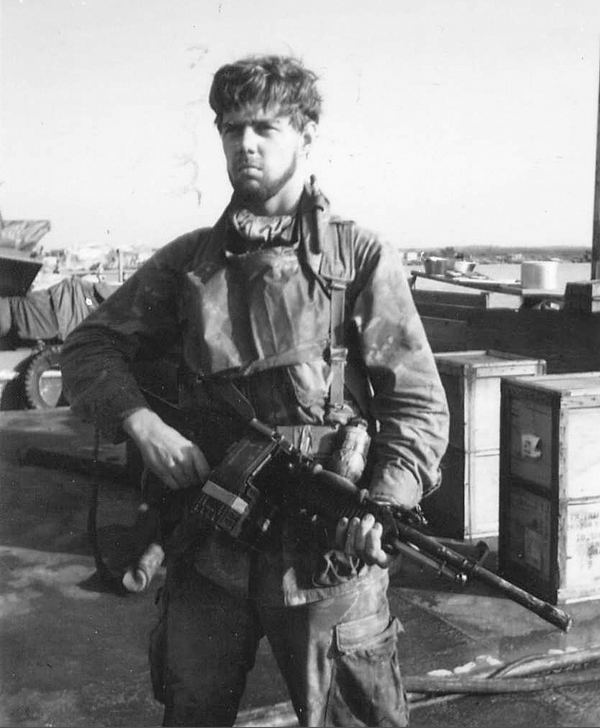
It had been a rough day at the office. Dirt, sweat, and blood covered me from head to toe. I was tired, and the wound in my shoulder felt as if it went all the way to the bone. My prisoner was in worse shape, having taken several rounds in his gut. All I wanted was to get back to our base at SEAFLOAT and tend to my wounded prisoner. Technically successful, the operation had netted a high level Viet Cong chief without losing any of our own. The degree of success, however, depended on whether the prisoner survived. I managed to stabilize him during the helicopter flight back. After we set down, I climbed wearily from the chopper onto the deck of our massive floating base, only to find myself face to face with the business end of a 16mm Arriflex. A quick look around confirmed my worst fears. Despite being anchored in the middle of a two mile wide river, we had been invaded. But not by the Viet Cong—a TV News crew lay in ambush. Of the two, newsmen were worse. At least I was allowed to shoot VC.
Against my better judgment I left my Stoner machine gun in its place across my back, gritted my teeth and pushed past the Arriflex camera to escort my prisoner to sickbay. My first priority was to make certain this particular VC Chief would live long enough to talk. I must have looked even worse than I felt, because the newsman quickly retreated.
When I returned from sickbay some time later, feeling a little groggy and light headed from blood-loss; I was again assaulted by the camera’s fish-eye stare as the lens was shoved into my face. A microphone held by a freshly shaved man with TV good looks blocked my escape route. He must have come straight from an air-conditioned suite in Saigon because he was just beginning to sweat. I shifted my weapon slightly to relieve the stress on my injured shoulder, and wondered if this man realized he stood between me and a long, cool, shower.
“So what’s your name, soldier?”
“McPartlin. What’s yours?”
“Morely Safer.” He nodded towards sickbay. “How’s your prisoner?” He must have seen the hesitation on my face. “It’s okay. We’re here with Admiral Zumwalt. His aide said we could look around here at SEAFLOAT.”
“Uh huh.” I tried to sound non-committal. I heard that Admiral Zumwalt had planned a visit to see his son Elmo, a Swift Boat commander with our base, but I didn’t realize he was bringing a herd of newsies with him.
“Your prisoner …?”
“He’ll live.” I turned to walk away, hoping he would get the message, but he became as tenacious as delta river mud, sticking right to me.
“So what’s your first name, McPartlin?”
“Greg.”
“And what’s your rate?”
“I’m a Navy SEAL.” That was at least something I was proud to share, and something he probably already knew.
“Do you have a rate?”
“E-5”
“That’s your rank. What’s your rate?”
This guy definitely did not get the message.
“HM2, Corpsman.” I snapped and kept walking. He continued to follow close behind me.
“So what’s that on your back?” He gestured towards my Stoner.
I stopped and turned to face Mr. Safer, releasing my weapon with my good arm while wishing I could show it to him up close and personal.
“This,” I said, “is my Stoner 5.56 mm belt fed, gas operated machine gun. It has a rate of fire of around one thousand rounds a minute.” I did my best to sound like my instructor back at Coronado.
He appeared to admire the weapon for a moment, then fixed his intense newshound-gaze on me. “So what is a medic doing with a machine gun? That isn’t standard corpsman equipment.”
I just looked at him, unable to believe he would ask a question like that in the middle of a war. Especially this war. “Well then, think of it as a surgical instrument capable of making up to a thousand incisions per minute.”
Rather proud of my impromptu response, I couldn’t hide my grin as I resumed walking to our living area or “hooch” as it was called in the native dialect.
“Hey,” he called after me. “Don’t you know it’s against the Geneva Convention for a corpsman to carry anything more than a side arm?”
I stopped, turned and looked him in the eye. The smile drained from my face to be replaced by a sneer of disgust. I stepped towards this sack of shit in his starched clean cammies and leaned in until my face was only inches from his, silently reminding myself that throttling reporters went against more than the Geneva Convention. As I glared at him, the sweat started to bead up on his forehead. I could smell his Aqua Velva aftershave and I wanted to be certain he could smell the stench of sweat, shit, and dried blood that permeated my clothes and body. I wanted this pretty-boy, who probably never slept outside of a nice hotel, to get a good whiff of life in the bush. During the mission I had given CPR to the wounded prisoner, who had regurgitated in my mouth, so I knew my breath was far from minty-fresh.
“And I suppose you think I should wear a big red X on my helmet as well? Who the fuck has heard of the Geneva Convention out here? Certainly not Charlie!”
Before the startled Mr. Safer could reply, Admiral Zumwalt, who must have seen the newsman accost me, stepped in and saved him. While still maintaining the guise of the generous host, he smoothly confiscated the film from the protesting Mr. Safer and passed it to his aide.
“Gentleman,” he announced, making certain he had the attention of the entire news crew. “These men…” he gestured to include me as well as the members of my platoon who had started to gather in the area, “…are Navy SEALs. They and this area of SEAFLOAT are off limits to you or any other members of the press. They do not exist. You never saw them. And, to quote a cliché, if you ask them anything else, they’ll have to kill you.” He smiled as he said it—possibly to underline the humor of his words—but the smile was predatory. Mr. Safer glanced over at me. I grinned dangerously, letting him know that I would be only too glad to carry out that threat, cliché or not.
I watched for a moment as the cowed newsmen left the area, then resumed my march to our hooch. My buddy and teammate Wayne Bohannan stopped me long enough to take charge of my Stoner so I could shower and get my wound attended. Just outside the showers, the Admiral’s aide caught up with me.
“Doc, the Admiral would like you to know that we all agree with what you said to the reporter. It’s how we all feel. But,” his eyes twinkled “he also says you are definitely not going to get that appointment as the public affairs officer.”
I laughed and gave him a thumbs-up, then turned and climbed into the shower, web gear and all.
Under the cool spray, I began peeling off the last 36 hours along with my cammies and gear, watching as the water turned dark from dirt and blood. I thought about what the reporter had said. I understood his point, but I sure as hell didn’t agree with him. The Geneva Convention was useless in a war where the enemy considered any means justifiable in the pursuit of their goal. To someone who used children to deliver bombs, a red cross was a nice clear target, and a wounded soldier simply provided a lure to force another target into range. In Vietnam, anyone who did not go into the bush prepared to fight became a liability for his entire unit. This proved especially true within a SEAL unit. I understood that. But I also realized that someone who had never been in battle would have a hard time understanding why a medic needed to be able and willing to kill. Fact remained, I had been trained to kill as efficiently and effectively as to heal. Both skills usually ended up saving lives, and I had few regrets. But I hadn’t started out to be a killer. I had started out as a healer.